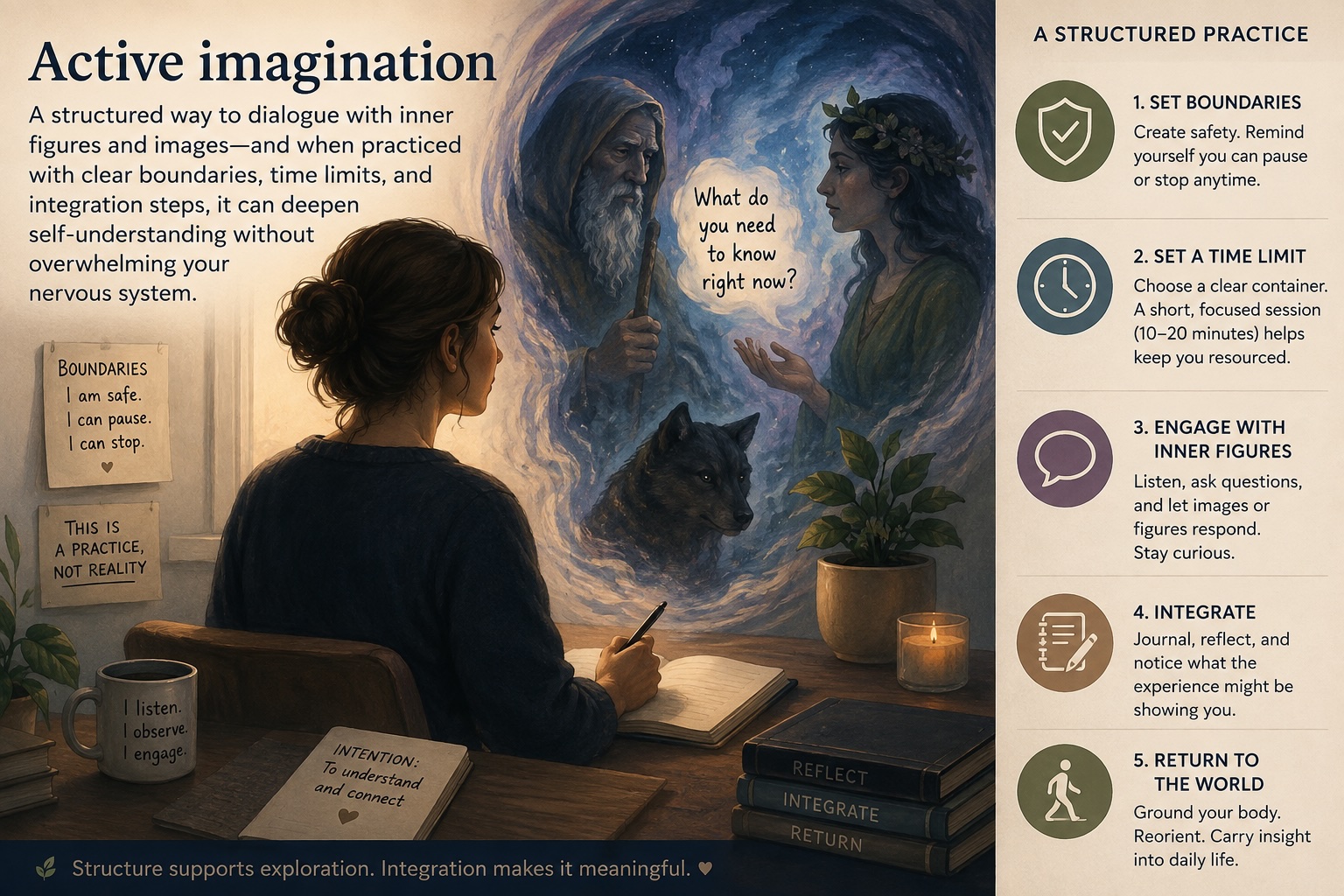
If you’ve ever finished a journal entry and felt like you were standing at the edge of something—an image, a mood, a half-formed “someone” inside you—then you already know the doorway active imagination uses. Journaling often clarifies your thoughts. Active imagination goes one step further: it lets the psyche answer back. That can feel exciting, uncanny, or surprisingly tender. It can also feel like too much, too fast, if you don’t set the right container.
Thesis: Active imagination is a structured way to dialogue with inner figures and images, and when practiced with clear boundaries, time limits, and integration steps, it can deepen self-understanding without overwhelming your nervous system.
WHAT ACTIVE IMAGINATION IS (AND ISN’T)
In plain terms, active imagination is a method of engaging with spontaneous inner material—images, characters, landscapes, sensations, even a “voice” that doesn’t feel like your usual inner monologue. Instead of analyzing it from a distance, you enter into relationship with it. You ask questions. You listen. You respond. You let the image develop.
For journalers, it can feel like moving from “I’m writing about my anger” to “I’m meeting the part of me that carries anger, and I’m letting it speak.”
What it isn’t: a performance, a trance you force, or a way to “manifest” outcomes. It’s also not a replacement for therapy, especially if you’re dealing with trauma, dissociation, or intense intrusive material. Think of it like a conversation with the unconscious: meaningful, sometimes surprising, and best held in a safe room with a door you can close.
WHY JOURNALERS HAVE AN ADVANTAGE
If you already journal, you have three skills that make active imagination safer and more fruitful.
First, you can observe yourself. You know how to notice shifts in mood and thought without immediately acting on them.
Second, you can put experiences into words. That matters because language helps integrate imaginal material into conscious life.
Third, you already have a ritual: a time, a place, a familiar process. Active imagination benefits from ritual because ritual signals to the psyche: “This has a beginning and an end.”
The main new skill is learning to relate to inner content as if it has its own perspective, while still remembering: you are the one holding the pen.
BEFORE YOU BEGIN: BOUNDARIES ARE THE PRACTICE
A common misunderstanding is that the “real” work is what happens in the imaginal space. For beginners, the real work is containment. If you get containment right, the content can be intense without becoming destabilizing.
Here are the boundaries that matter most:
Time boundary: Set a short, non-negotiable window. For a first attempt, 10 to 15 minutes is enough.
Space boundary: Choose a place where you feel physically safe and unlikely to be interrupted. If possible, sit upright rather than lying down; it helps maintain a grounded stance.
State boundary: Don’t do active imagination when you’re sleep-deprived, intoxicated, or already emotionally flooded. If you’re at an 8 out of 10 in distress, choose soothing regulation first.
Role boundary: You are not surrendering control. You are entering a dialogue. If anything becomes too intense, you can pause, step back, open your eyes, and end the session.
Aftercare boundary: Plan a brief “return” ritual—water, a short walk, a snack, a few grounding breaths. This tells your nervous system the session is complete.
If you have a history of psychosis, severe dissociation, or trauma that easily overwhelms you, it’s wise to approach this with professional support. Active imagination can open doors; you want to make sure you have help if something rushes through.
A SIMPLE STEP-BY-STEP METHOD (10–15 MINUTES)
Step 1: Set the frame (1 minute) Write the date and a title like: “Active Imagination: Meeting the Feeling.” Note your intention in one sentence: “I want to understand the anxiety that’s been following me this week.”
Step 2: Find the entry point (2 minutes) Choose one of these as your starting image: A strong emotion you can locate in the body (tight chest, heavy stomach). A recurring dream fragment. A persistent mental image (a door, a storm, a child, an animal). A conflict you keep journaling about.
Then close your eyes briefly and let an image form around it. Don’t strain. You’re inviting, not forcing.
Step 3: Establish the scene (2 minutes) Ask: “Where am I?” Let a setting appear. It might be a room, a forest, a shoreline, a hallway. If nothing appears, imagine a simple neutral place like a bench in a quiet garden. The goal isn’t fantasy artistry; it’s a stable stage.
Step 4: Invite a figure to speak (5 minutes) Now ask the feeling or image to take form. You can say internally: “If this anxiety had a shape, what would it be?” Then let something appear: a person, an animal, a symbol, even an object.
Begin a written dialogue. Keep it simple: You: Who are you? Figure: (Write whatever comes, even if it surprises you.) You: What do you want me to know? Figure: … You: What do you need from me? Figure: …
A key point: you’re not trying to be “nice” or “spiritual.” You’re trying to be honest and curious. If the figure is hostile, you can set boundaries there too: “You can speak, but you can’t threaten me. What are you protecting?”
Step 5: Ask for one small next step (2 minutes) Before ending, ask: “What is one small thing you want me to do in my actual life this week?” The answer should be realistic. If it’s grandiose or extreme, negotiate: “That’s too big. What’s a smaller version?”
Step 6: Close the session (1 minute) Thank the figure. Then imagine leaving the scene: walking out the door, closing a book, turning down a dimmer switch. Open your eyes. Write: “Session closed.”
That closing gesture matters more than people think. It’s how you keep the imaginal from bleeding into everything.
EXAMPLE: THE INNER CRITIC AS A WORRIED GUARD
A journaler I’ll call Maya kept writing about a harsh inner critic. Every entry ended the same way: “I’m tired of being mean to myself.” When she tried active imagination, she expected a villain.
She pictured a narrow hallway with bright lights. At the end stood a security guard with a clipboard, stern and rigid. She asked, “Why are you so strict?” The guard replied, “Because if you relax, something will go wrong and everyone will see.”
That single sentence shifted the whole relationship. The critic wasn’t just cruelty; it was fear dressed as authority. Maya asked what the guard was protecting. The answer: a younger part that felt humiliated years ago. The guard believed perfection could prevent that pain from returning.
Integration didn’t mean “fire the guard.” It meant updating his job description. Maya wrote a new boundary: “You can warn me, but you can’t insult me.” She also took a small real-world step: before submitting work, she asked a trusted friend for one piece of feedback, so the “guard” didn’t have to do it alone.
Active imagination didn’t erase the critic. It turned an enemy into a function, and a function into a conversation.
COMMON PITFALLS (AND HOW TO STAY GROUNDED)
One pitfall is over-identifying with the figure. If an inner voice says, “Quit your job tomorrow,” treat it as data, not a command. Ask: “What feeling is behind that?” Often the psyche speaks in dramatic images to express a real need: rest, recognition, autonomy, safety.
Another pitfall is turning the dialogue into a scripted story. If you notice you’re forcing it, return to sensation: “What do I feel in my body right now?” Let that guide the next line.
A third pitfall is chasing intensity. Beginners sometimes think the session “worked” only if it was cinematic or emotional. In practice, subtle sessions are often the most integrating. A quiet image that leaves you calmer can be more valuable than a dramatic confrontation that leaves you raw.
Finally, there’s the pitfall of skipping integration. Without integration, active imagination can become a private theater—absorbing, but disconnected from change.
INTEGRATION: TURN INSIGHT INTO SUPPORT
After the session, do three things.
Name it: In one or two sentences, summarize what happened in plain language. Example: “My anxiety appeared as a small animal hiding under a chair. It wanted me to stop rushing and check my schedule.”
Normalize it: Remind yourself this is psyche-language—symbolic, meaningful, not literal. This reduces the chance you’ll either dismiss it as nonsense or treat it as absolute truth.
Narrow it: Choose one small action that honors the message without overhauling your life. If the figure asked for rest, maybe you schedule a 20-minute break twice this week. If it asked for honesty, maybe you tell one trusted person what you’ve been avoiding.
You can also track patterns over time. Do certain figures return? Do they change as you change? The psyche often repeats an image until it feels heard.
WHEN TO PAUSE AND SEEK MORE SUPPORT
If sessions consistently leave you more anxious, dissociated, or unable to function, that’s a sign to slow down. If you encounter traumatic memories or overwhelming fear, prioritize stabilization and consider doing this work with a skilled therapist. Active imagination is powerful, but power without containment isn’t depth—it’s risk.
A helpful rule: you should feel more connected to life after the session, not less. Not necessarily cheerful, but more present, more able to choose your next step.
CONCLUDING TAKEAWAY
Active imagination is like upgrading journaling from a monologue to a relationship. The goal isn’t to escape reality; it’s to bring back something useful—an insight, a softened stance, a new boundary, a small act of care. If you approach it with a clear time limit, a firm closing ritual, and a commitment to integration, it can become a steady practice that supports shadow work without turning your inner world into a storm you can’t leave.
Soon the blog will be viewable for free and premium users of the app.