You can fall for someone in a week and then—almost overnight—feel confused, irritated, or oddly betrayed by them without any clear external reason. Or you can sit down to create something and feel as if a hidden hand either blesses the work with flow or sabotages it with doubt. These swings often get blamed on “chemistry,” “attachment issues,” or “overthinking.” Jung offered another angle: a relationship is never only between two people. It’s also between you and the inner figures you bring to the meeting.
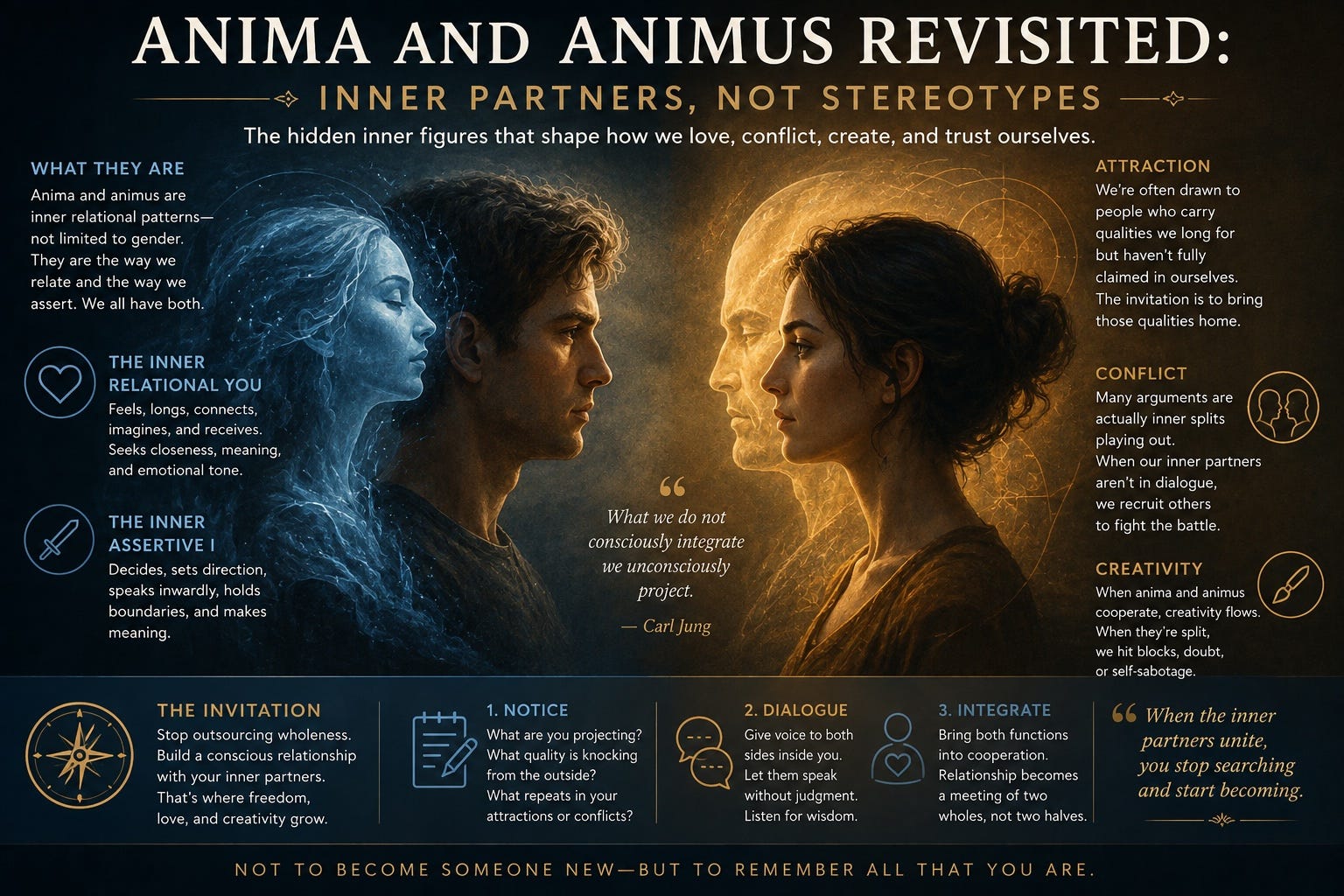
Thesis: Anima and animus are best understood today not as gendered boxes but as inner relational patterns—inner partners that shape how we bond, argue, idealize, create, and trust ourselves. When we relate to these patterns consciously, attraction becomes clearer, conflict becomes more workable, creativity becomes more accessible, and self-trust stops depending on someone else’s approval.
WHAT ANIMA/ANIMUS CAN MEAN WITHOUT THE BAGGAGE
Traditional Jungian language framed the anima as the inner feminine in a man and the animus as the inner masculine in a woman. In modern life, that framing can feel dated or exclusionary. But the psychological core is still useful if we translate it.
Think of anima/animus as two complementary inner functions:
One function is the inner “You” that relates—how you imagine closeness, what you long for, what you fear will happen if you open, the tone of your inner emotional world, and the kind of presence you crave from others.
The other function is the inner “I” that asserts—how you decide, speak inwardly, set direction, hold boundaries, interpret meaning, and form convictions.
Every person has both. They aren’t tied to biological sex or identity. They’re patterns of psyche that develop through early relationships, cultural expectations, and personal temperament. In Jung’s terms, they often appear as inner figures because the mind naturally personifies what it hasn’t yet integrated. We meet them first as “someone else,” then slowly learn to recognize them as “also me.”
Seen this way, the anima/animus are inner partners: one more oriented toward relatedness, feeling-tones, and receptivity; the other more oriented toward agency, discernment, and direction. When they cooperate, you feel whole. When they split, you either chase completion through others or harden into self-sufficiency that secretly aches.
ATTRACTION: WHEN YOUR INNER PARTNER CHOOSES FOR YOU
A lot of attraction is projection: the psyche recognizes in another person something it wants to reclaim in itself. That’s not an insult to love; it’s part of love’s ignition. The trouble begins when we don’t realize what we’re projecting.
Consider Maya, who keeps falling for “quiet, grounded” partners. The first month feels like relief. She tells herself, “Finally, someone stable.” But soon she experiences their calm as distance and becomes anxious, then critical. Underneath, Maya has an inner pattern that longs for steadiness and containment—qualities she doesn’t fully trust in herself. She’s drawn to someone who carries that energy for her. When the initial projection wears off, she has to face the real person, and also face her own undeveloped capacity for inner steadiness. If she can build that capacity, her attraction becomes less compulsive and more choiceful.
Or take Daniel, who is magnetized by charismatic, expressive partners. He feels more alive around them, more creative, more romantic. Later he feels eclipsed, as if there’s no room for him. His inner relational pattern has outsourced vitality and emotional expression. He’s chosen a partner to live those qualities on his behalf. The relationship becomes a stage where his own unlived feelings demand attention.
In both cases, the “inner partner” is selecting the outer partner. The invitation is not to stop being attracted, but to ask: What quality is my psyche trying to bring home? What part of me is knocking from the outside?
CONFLICT: THE INNER COUPLE THAT FIGHTS IN YOUR SENTENCES
Many arguments aren’t really about the dishes, the text message, or the tone. They’re about an inner split: one part wants closeness now; another part wants safety through distance. One part wants to be understood; another part wants to be right. When these parts aren’t in dialogue inside you, they recruit your partner as a stand-in.
A common pattern: you feel hurt, but instead of saying “I’m hurt,” you become prosecutorial. You deliver a closing argument. That’s often the assertive inner function taking over to protect the vulnerable relational function. The goal isn’t connection; the goal is control. You might win the point and lose the bond.
Another pattern: you feel anger, but instead of stating a boundary, you go quiet, get agreeable, and then resentful. That’s often the relational function trying to preserve connection at any cost, while the assertive function goes underground and returns as passive aggression.
Here’s a small practice that can change the temperature of conflict: after an argument, write down two voices as if they were two characters in you. One voice speaks from longing, fear, tenderness. The other speaks from certainty, judgment, direction. Let them each say what they want and what they’re afraid of. When you do this, you often discover that the “harsh” voice is terrified of helplessness, and the “soft” voice is terrified of abandonment. The moment you can hear both, you’re less likely to make your partner carry one of them alone.
CREATIVITY: THE MUSE AND THE EDITOR AS A HEALTHY PAIR
Jung noticed that the anima/animus often appear in dreams and fantasies around creative work. In modern terms, creativity needs both receptivity and discernment: the ability to let something emerge, and the ability to shape it.
When the receptive function is blocked, you can’t access play, intuition, or emotional color. You might produce competent work that feels lifeless, or you might avoid creating altogether because nothing “moves.” When the discerning function is blocked, you may have endless ideas with no structure, or you may start projects that never land.
Anecdote: a musician describes two states. In one, songs arrive as if “from somewhere else,” and she feels guided. In the other, she hears only criticism: “This is derivative. This won’t matter.” She assumed the second state was simply realism. But when she began treating that voice as an inner figure with a job—protecting her from exposure—she could negotiate with it. She’d say, “Thank you. You can edit later. Right now we’re writing.” Over time, the critical voice softened because it no longer had to shout to be heard.
This is the inner couple at its best: the muse and the editor, the dreamer and the decider. Creativity flourishes when you can welcome the unknown without being swallowed by it, and evaluate without killing what’s tender.
SELF-TRUST: WHEN YOUR INNER PARTNER BECOMES AN ALLY
Self-trust isn’t just confidence. It’s the felt sense that you can be with your own emotions and make decisions without abandoning yourself. Anima/animus work, reframed as inner relational work, is essentially about building an inner relationship that can hold both feeling and direction.
When the inner relational function is underdeveloped, you may not know what you feel until it becomes a crisis. You might seek people who “tell you who you are” because your inner mirror is blurry. When the inner discerning function is underdeveloped, you may feel flooded by emotion and unsure what to do with it. You might seek people who “lead” you because your inner compass feels unreliable.
Integration looks like this: you can feel deeply without losing your footing, and you can choose firmly without becoming cold. You can grieve and still act. You can desire and still discern. You can be open and still boundaried. That’s not a personality type; it’s inner partnership.
A practical reflection: Think of a recent moment when you doubted yourself. What did the doubting voice say, exactly? Was it more like a scolding authority, or more like a frightened child? Now ask: what would a wise inner partner say instead—one that respects your feelings and also respects reality? Writing that response is a small act of re-parenting, but it’s also anima/animus work in contemporary language: building an inner dialogue that’s supportive rather than polarized.
WORKING WITH THESE PATTERNS WITHOUT TURNING THEM INTO DOGMA
The goal isn’t to label every mood as “anima” or “animus.” The goal is to notice when an inner figure has taken the steering wheel.
Signs you’re in projection: your emotional reaction is bigger than the situation; you’re certain you “know” who the other person is; you feel fated, obsessed, or unusually threatened.
Signs you’re in inner split: you alternate between craving closeness and pushing it away; you either over-explain or shut down; you can’t locate what you want.
A gentle way forward is to treat your inner patterns as characters in a story you’re learning to read. Dreams can help, but so can ordinary life. Who do you become in romance? Who do you become in conflict? Who do you become when you try to create? Each “who” is a clue to an inner relationship asking to mature.
If you want a simple prompt for shadow work: “What quality am I demanding from others that I have not yet practiced giving to myself?” That question often reveals the hidden contract behind attraction and the hidden fear behind control.
CONCLUDING TAKEAWAY
Anima and animus don’t have to be relics of gender stereotypes. They can be a living map of inner relationship: the part of you that longs and the part of you that leads, the part that feels and the part that decides. When these inner partners are unconscious, you look for completion outside yourself and fight about it when it fails. When they become conscious, you still love, still desire, still create—but with less compulsion and more clarity. Attraction becomes information, conflict becomes dialogue, creativity becomes collaboration, and self-trust becomes an inner bond you can rely on.
If you want more reflections like this—practical Jungian concepts you can apply to real relationships and real inner work—subscribe and stay with us.