Why do certain characters seem to appear everywhere?
The wise mentor. The threatening stranger. The protective mother. The hero leaving home. The trickster who disrupts everything. The mysterious figure who appears in a dream and somehow feels more significant than an ordinary person.
Carl Jung believed these recurring patterns were not accidents.
He called them archetypes: deep patterns within the human psyche that shape the way we experience ourselves, other people, dreams, stories, religion, and the world around us.
Archetypes are one of the most influential—and controversial—ideas in Jungian psychology. They help explain why myths written thousands of years ago can still feel psychologically familiar, why similar symbols emerge in cultures separated by enormous distances, and why our dreams sometimes seem to speak in a language that feels older than our conscious mind.
But Jung did not intend archetypes to become personality labels.
You are not simply “the Hero” or “the Caregiver.”
Archetypes are better understood as patterns of psychological experience that can become active within us at different moments in our lives.
Understanding them can therefore become a powerful tool for self-reflection.
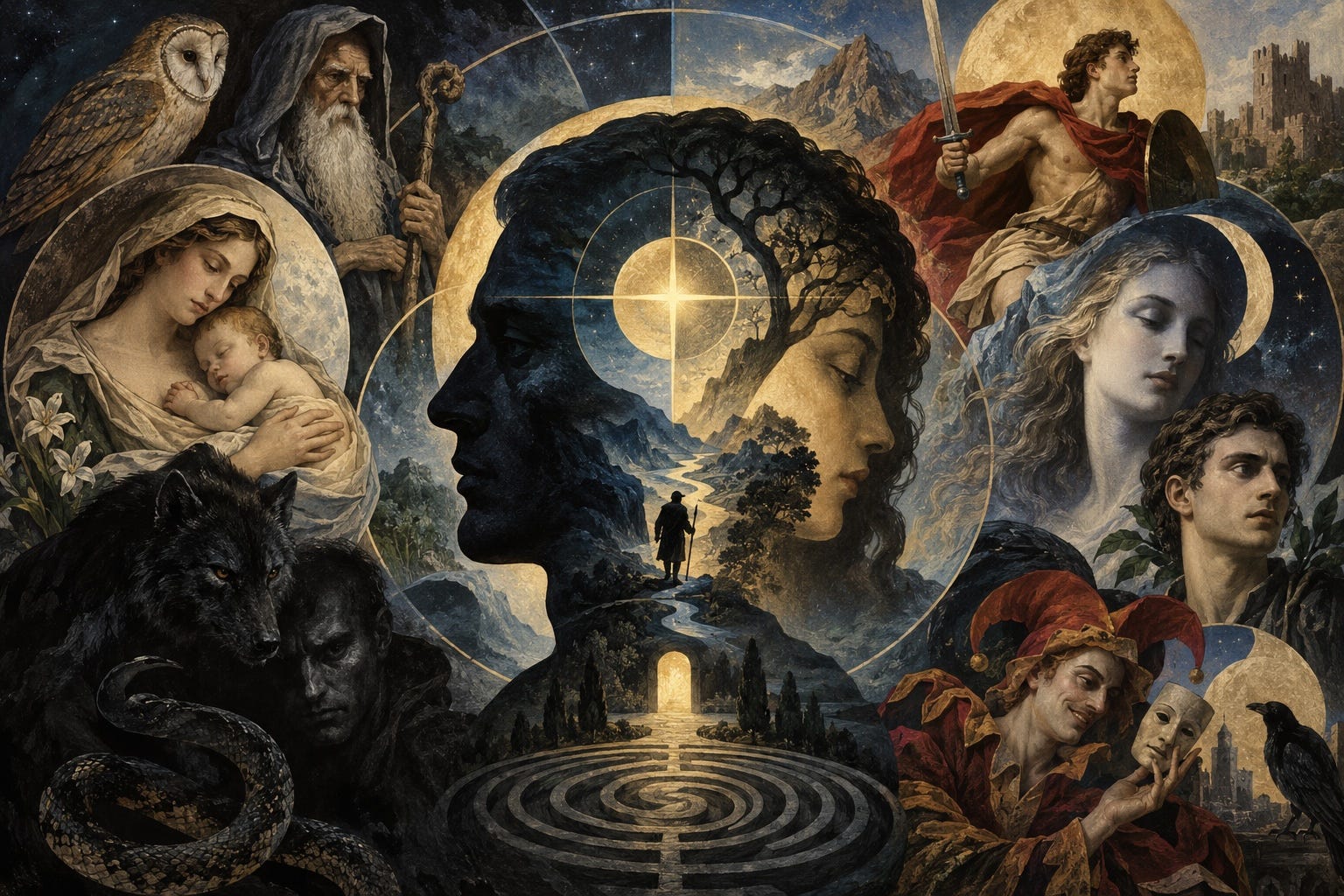
What Is an Archetype?
To understand archetypes, we first have to understand how Jung viewed the unconscious.
Most people are familiar with the idea of a personal unconscious: memories, emotions, experiences, impulses, and conflicts that remain outside our immediate awareness.
Jung believed another layer existed beneath it.
He called this the collective unconscious.
Unlike the personal unconscious, which develops through our individual experiences, Jung proposed that the collective unconscious contains inherited psychological structures shared by humanity.
Archetypes are the patterns that emerge from this deeper layer.
Jung did not mean that people inherit fully formed images like a mental photograph of a hero, mother, or wise old man.
Instead, an archetype can be thought of as a psychological predisposition—a structure that influences how certain fundamental human experiences are perceived and expressed.
Birth.
Death.
Parenthood.
Conflict.
Love.
Fear.
Transformation.
Authority.
Separation.
The search for meaning.
Human beings have confronted these experiences throughout our entire history. Jung believed the psyche developed recurring patterns around them.
Those patterns then find expression through symbols.
A culture may describe a warrior battling a dragon.
Another may tell of a traveler descending into the underworld.
Someone today may dream that they are entering a dark basement and encountering a threatening stranger.
The imagery changes.
The psychological pattern underneath it may be remarkably similar.
Archetypes Are Patterns, Not Fixed Characters
Popular culture has sometimes simplified Jungian psychology into a catalog of character types:
The Hero.
The Mother.
The Trickster.
The Sage.
The Lover.
The Ruler.
These categories can be useful, but they can also create the mistaken impression that Jung believed the psyche contained a fixed cast of characters.
His concept was more fluid.
Archetypes reveal themselves through archetypal images.
The archetype itself is the underlying pattern. The image is the form that pattern takes within a particular person, dream, religion, myth, or culture.
The archetype of transformation, for example, might appear as:
a death and rebirth
a journey through darkness
a snake shedding its skin
a ruined building being reconstructed
crossing a river
entering a forest
descending underground and later returning
The individual symbol matters.
But Jung would also ask what larger psychological process the symbol might be expressing.
This distinction becomes especially important when working with dreams.
A snake does not have one universal definition.
Neither does water, a house, a child, a stranger, or death.
The meaning of a dream symbol depends partly on the dreamer.
Archetypal interpretation asks us to consider both the personal meaning of the image and the larger human pattern it might represent.
The Persona: The Face We Show the World
One of Jung’s most accessible concepts is the Persona.
The word originally referred to a theatrical mask.
Psychologically, the Persona is the identity we present to the outside world.
We all need one.
You may behave differently while speaking to your employer than you do while talking to your closest friend. A teacher, police officer, physician, parent, manager, or performer may step into a particular social identity when fulfilling that role.
The Persona allows us to function within society.
The problem begins when we confuse the mask with the whole person.
Someone may become so identified with being competent that they cannot admit weakness.
Another may become so attached to being agreeable that they cannot express anger.
Someone whose identity centers entirely around professional success may feel psychologically lost after retirement or job loss.
The Persona itself is not false.
It simply becomes dangerous when we forget there is more behind it.
Jungian development often requires asking:
Who am I when I am no longer performing the role other people expect from me?
That question leads directly toward another archetypal figure.
The Shadow.
The Shadow: What We Refuse to See in Ourselves
The Shadow contains qualities we have difficulty accepting as part of ourselves.
Some may seem obviously negative:
anger
jealousy
selfishness
aggression
envy
resentment
sexual desire
the desire for power
But the Shadow is not simply an evil version of the personality.
People can repress positive qualities as well.
Someone raised to remain quiet may push their assertiveness into the Shadow.
Someone taught that ambition is selfish may deny their desire to accomplish something meaningful.
A person who learned that vulnerability is dangerous may bury their tenderness along with their fear.
This is one reason Shadow work is more complicated than merely “confronting your darkness.”
It involves discovering whatever the conscious personality has rejected.
One way the Shadow makes itself visible is through projection.
A trait we cannot tolerate within ourselves may become intensely noticeable in someone else.
The person who constantly condemns arrogance may secretly struggle with their own need for recognition.
Someone who prides themselves on always being rational may become disproportionately irritated by emotional people.
This does not mean every criticism is projection.
Sometimes another person really is arrogant, dishonest, reckless, or cruel.
The useful question is different:
Why does this particular quality produce such an intense reaction in me?
That emotional charge can sometimes point toward unconscious material.
The Anima and Animus: Encountering the Inner Other
Jung also developed the concepts of the Anima and Animus.
Historically, he described the Anima as the unconscious feminine dimension within a man and the Animus as the unconscious masculine dimension within a woman.
Modern Jungian thought often approaches these concepts more flexibly than Jung’s original gender framework.
The broader psychological idea remains compelling: the conscious personality contains an unconscious counterpart that carries qualities the ego has not fully integrated.
This figure frequently appears in dreams as a mysterious or emotionally powerful person.
They may appear as:
a guide
a stranger
a lover
a rival
a distant figure
a threatening presence
someone impossibly attractive
someone who seems to possess knowledge the dreamer lacks
Because this archetypal figure represents qualities beyond the ego’s familiar identity, encounters with it can feel unusually charged.
It can also influence relationships.
We sometimes place enormous psychological expectations onto another person because they seem to embody something missing within ourselves.
The relationship then becomes about more than the actual person.
We have projected part of our inner world onto them.
Recognizing that projection does not make love or attraction unreal.
It allows us to see the other person more clearly.
The Self: The Archetype of Wholeness
At the center of Jung’s psychological model stands the Self.
The ego is the center of conscious identity—the “I” we normally think of as ourselves.
The Self represents something larger.
It encompasses the conscious and unconscious personality together.
For Jung, psychological development was therefore not simply about making the ego stronger.
It was about developing a relationship between the ego and the larger psyche.
Symbols associated with the Self often involve completeness and order:
circles
mandalas
squares
jewels
centers
sacred buildings
balanced geometric patterns
figures combining opposites
These symbols sometimes emerge spontaneously during periods of psychological upheaval.
Why?
Jung believed the psyche contains a tendency toward greater integration.
When conscious life becomes one-sided, unconscious material may appear in dreams, fantasies, emotions, or symbols that compensate for the imbalance.
The Self represents the possibility of becoming more psychologically whole.
Not perfect.
Whole.
There is an important difference.
The Hero: Leaving the Familiar World
The Hero is one of humanity’s most recognizable archetypal patterns.
The Hero leaves the familiar world, encounters danger, faces trials, and returns transformed.
We see this structure repeatedly in mythology and storytelling because it mirrors a psychological reality.
Growth often requires leaving an established identity behind.
Starting a business.
Ending a relationship.
Becoming a parent.
Leaving home.
Changing careers.
Confronting addiction.
Recovering after loss.
Standing against a family expectation.
Beginning therapy.
Acknowledging something about ourselves we would rather avoid.
Each can become a kind of psychological journey.
The dragon in a myth may therefore represent more than an external monster.
It can symbolize the fear guarding something psychologically valuable.
The Hero archetype reminds us that transformation often demands confrontation with what the ego would prefer to avoid.
But Jungian psychology also warns against identifying too strongly with the Hero.
Someone convinced that they must always overcome, conquer, rescue, or endure can become trapped by the very archetype that once helped them grow.
Every archetypal force contains both possibilities and dangers.
The Wise Old Man and Wise Woman
Another recurring figure is the wise guide.
Merlin.
The oracle.
The elder.
The hermit.
The teacher who appears at exactly the right moment.
The mysterious stranger offering advice.
These figures often symbolize knowledge existing beyond the ego’s current understanding.
In dreams, such a figure may appear when someone faces a problem their ordinary conscious strategies cannot solve.
That does not mean a dream character literally possesses supernatural knowledge.
Psychologically, the dream may be expressing something the unconscious has already recognized before the conscious mind has fully articulated it.
Sometimes the guide speaks.
Sometimes they simply lead the dreamer somewhere.
Sometimes they hand the dreamer an object.
The question then becomes:
What does this figure seem to know that I do not?
The Great Mother
The Mother archetype reaches far beyond one’s personal relationship with a biological mother.
It represents the larger psychological experience of creation, nourishment, protection, fertility, containment, and origin.
Its imagery appears throughout mythology:
Mother Earth.
The womb.
The garden.
The ocean.
The cave.
The vessel.
The home.
But archetypes contain opposites.
The nurturing mother can also become the devouring mother.
Protection can become control.
Safety can prevent development.
Care can become dependency.
The same archetypal force that gives life can refuse to let that life become independent.
This dual nature is typical of Jungian archetypes.
They rarely divide neatly into good and evil.
They contain possibilities at both ends of the psychological spectrum.
The Trickster: Chaos With a Purpose
The Trickster breaks rules.
He lies.
She disrupts.
It plays games.
The Trickster appears as the fool, joker, shapeshifter, mischievous god, outlaw, prankster, or troublemaker.
At first glance, the Trickster seems merely destructive.
But disruption can serve a psychological purpose.
When our conscious identity becomes rigid, chaos may expose its limitations.
The Trickster overturns certainty.
Rules that seemed unquestionable suddenly appear absurd.
A carefully maintained identity collapses.
Something unexpected interrupts the plan.
The experience may be unpleasant.
It may also create the possibility of change.
Psychologically, the Trickster asks:
What happens when the rules by which I have organized my life no longer work?
Archetypes in Dreams
Dreams were extraordinarily important to Jung because he believed they revealed the unconscious psyche in symbolic form.
A dream may contain ordinary material from daily life.
But occasionally a dream takes on a different quality.
It feels unusually vivid.
Strange.
Mythic.
Emotionally powerful.
A mysterious child appears.
An enormous animal watches from the darkness.
The dreamer descends underground.
A dead relative offers guidance.
A house contains an undiscovered room.
A flood destroys a city.
A stranger leads the dreamer across a bridge.
Jung described particularly powerful experiences of this kind as having a numinous quality—a sense that something psychologically significant is occurring.
Archetypal interpretation does not mean reaching for a dream dictionary.
Instead, several questions can be asked:
What was happening in my life when I had this dream?
What emotions did the image evoke?
What does this symbol mean to me personally?
Where have similar images appeared in mythology, religion, literature, or culture?
Does the dream compensate for an attitude I have become too identified with?
What part of myself might this dream figure represent?
These questions transform dream interpretation from decoding symbols into a conversation with the unconscious.
Archetypes in Relationships
Archetypes do not remain inside dreams.
They can also shape relationships.
A manager becomes the Tyrant.
A romantic partner becomes the perfect Anima or Animus figure.
A therapist becomes the Wise Guide.
A rebellious child becomes the Trickster.
A charismatic leader becomes the Hero.
When this happens, we may stop seeing the actual human being clearly.
They become the screen onto which an archetypal story is projected.
The emotional intensity can be enormous precisely because we are reacting to more than the immediate relationship.
One clue is disproportion.
When admiration, hatred, fear, attraction, or resentment seems vastly larger than the situation itself, there may be something worth examining.
The question becomes:
What psychological role has this person begun to represent for me?
That question can reveal as much about ourselves as it does about them.
Archetypes and Individuation
Ultimately, Jung’s archetypes cannot be separated from his larger idea of individuation.
Individuation is the lifelong process of becoming more fully oneself.
It does not mean becoming more individualistic.
Nor does it mean constructing the perfect personality.
Instead, individuation involves developing a more conscious relationship with parts of the psyche that previously operated outside awareness.
The Persona is recognized as a mask rather than the whole personality.
The Shadow is confronted rather than simply projected outward.
Inner opposites are gradually acknowledged.
The ego learns it is part of something psychologically larger than itself.
The goal is integration.
This is why Jungian psychology often returns to paradox.
Strength and vulnerability.
Reason and emotion.
Light and darkness.
Independence and connection.
Conscious intention and unconscious desire.
The mature personality does not necessarily eliminate one side.
It becomes capable of holding both.
Are Jung’s Archetypes Scientifically Proven?
Jung’s theory remains controversial within psychology.
The collective unconscious and archetypes are difficult to test using conventional experimental methods. Critics argue that archetypal interpretations can become too flexible: almost any story or image can potentially be interpreted through an archetypal framework.
That criticism is important.
Jungian psychology should not be treated as though every dream symbol has an objectively proven meaning.
Its enduring value lies somewhere different.
Archetypes provide a framework for exploring symbolism, personality, mythology, dreams, relationships, and the stories through which human beings understand their lives.
They give us questions rather than laboratory measurements.
And sometimes a powerful question can reveal something that a simple label cannot.
Recognizing Archetypes in Your Own Life
You do not need to memorize dozens of archetypes to begin thinking in Jungian terms.
Instead, pay attention to repetition.
What type of conflict keeps appearing in your relationships?
Which characters repeatedly show up in your dreams?
What traits in other people provoke unusually strong reactions?
Which roles have become central to your identity?
What stories, myths, films, or characters have fascinated you for years?
What parts of yourself feel unacceptable?
Where does your life currently seem to demand change?
Archetypes become meaningful when they connect with lived experience.
A dream about entering a forest matters because you entered the forest.
The psychological task is not merely determining what “forest” means.
It is discovering what entering that forest might mean at this particular moment in your life.
The Archetype Is Not the Answer—It Is the Beginning of the Question
Jung’s psychology does not offer a simple map where every symbol leads to one interpretation.
That would contradict the complexity of the psyche he spent his life studying.
Archetypes instead provide another way of looking at human experience.
Behind an argument may be a Shadow projection.
Behind an obsession may be an unconscious longing.
Behind a dream stranger may be an undeveloped part of ourselves.
Behind the collapse of an old identity may be the beginning of individuation.
And behind the stories humanity has told for thousands of years may be psychological patterns we continue to encounter within ourselves.
Perhaps this is why archetypes remain compelling.
They suggest that while every human life is unique, some of the psychological territory through which we travel is ancient.
We encounter it in mythology.
We encounter it in relationships.
We encounter it in dreams.
And, ultimately, we encounter it within ourselves.
Explore Your Own Jungian Patterns
Jungian Psyche AI is designed as a reflective tool for exploring dreams, archetypes, Shadow material, individuation, and other concepts inspired by Jungian psychology.
Rather than treating symbols as having one fixed meaning, Jungian reflection becomes most useful when a symbol is considered alongside your personal experiences, emotions, associations, and current circumstances.
If a dream, recurring pattern, or powerful emotional reaction has been staying with you, it may be worth asking:
What is my psyche trying to bring into consciousness?
Sometimes that question is where the real exploration begins.
Jungian Psyche AI is intended for personal reflection and education and is not a substitute for psychotherapy, diagnosis, or professional mental health care.