There’s a particular kind of frustration that shows up after you’ve read enough Jung to know the vocabulary, done enough journaling to recognize your patterns, and still find yourself repeating the same emotional loops. You can name your shadow. You can spot your projections. You can even describe your complexes with impressive clarity. And yet, in the moments that matter—an argument with a partner, a sudden career decision, a familiar spiral of shame—your “insight” feels like it lives in a different room than your actual life. That gap is often where individuation truly begins.
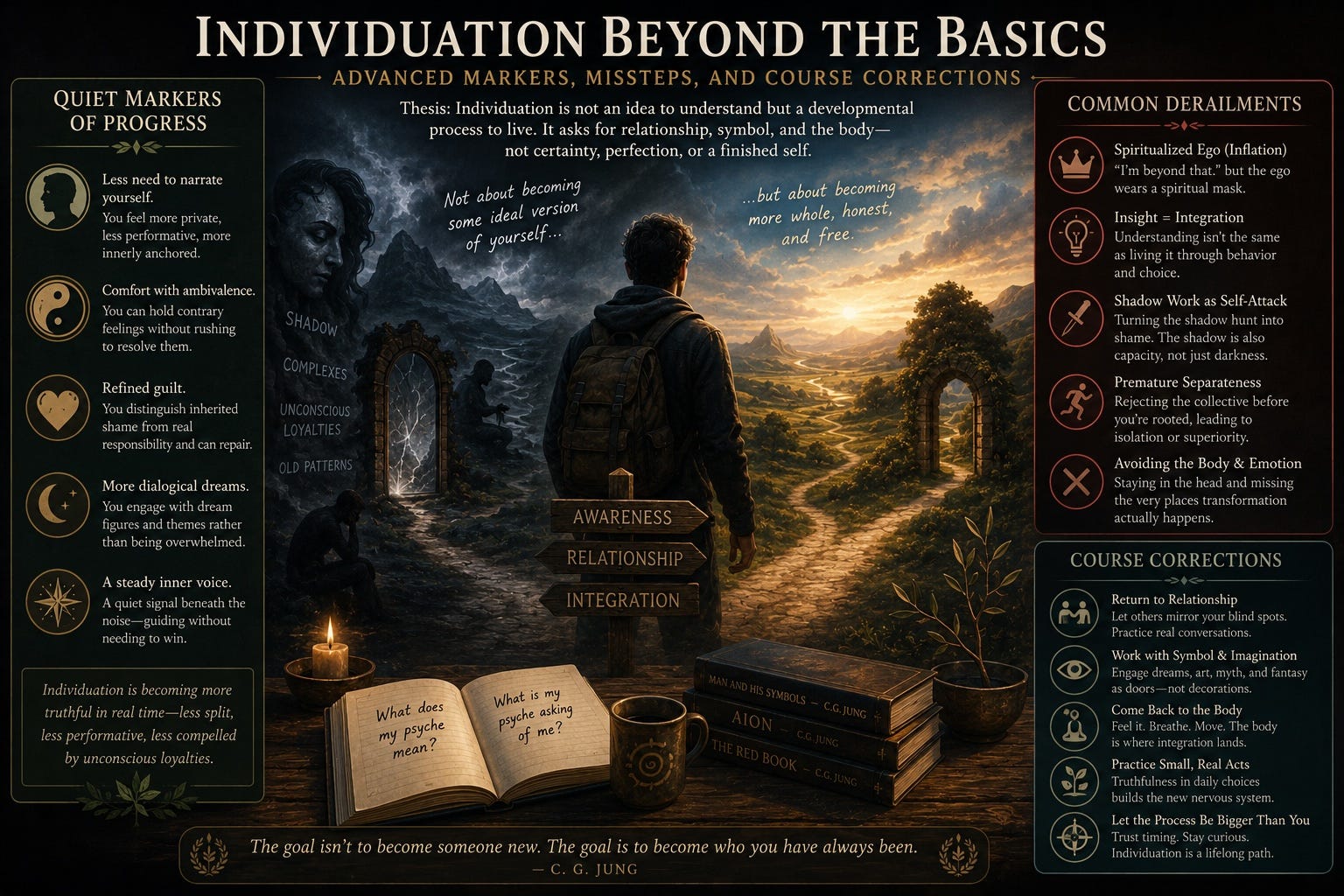
Thesis: Individuation is not an idea to understand but a developmental process to live. Its progress often shows up in subtle, unglamorous markers; it can be derailed by spiritualized ego, premature certainty, or avoidance disguised as growth; and it can be recalibrated by returning to relationship, symbol, and the body—without forcing outcomes or trying to “finish” the self.
WHAT INDIVIDUATION LOOKS LIKE WHEN IT’S REAL
Individuation is frequently imagined as becoming more “yourself,” as if the self were a fixed object you uncover like an artifact. In lived experience, it’s more like becoming more truthful in real time—less split, less performative, less compelled by unconscious loyalties. It doesn’t always feel like improvement. Often it feels like losing certain comforts: the comfort of being right, the comfort of being seen a certain way, the comfort of a clean identity.
A subtle but important shift happens when you stop asking, “What does my psyche mean?” and start asking, “What is my psyche asking of me?” The first can remain conceptual. The second requires response.
Consider a simple example: someone who has long identified as “the responsible one” begins noticing resentment toward friends who seem carefree. At the basic level, they might label this as shadow material: “I disown my own irresponsibility.” At a more lived level, individuation might require a specific risk: letting someone down in a small way, saying no without explanation, allowing a messy weekend, or admitting they don’t know what they want. The psyche doesn’t only want to be understood; it wants to be integrated into action, choice, and relationship.
ADVANCED MARKERS OF PROGRESS (THE QUIET KIND)
A common misunderstanding is that progress should look like constant calm, constant confidence, or constant “alignment.” Individuation tends to produce something more nuanced: a greater capacity to hold tension without premature closure.
One marker is a reduced need to narrate yourself. You may notice you’re less interested in curating an identity—less compelled to explain your motives, justify your feelings, or make your growth legible to others. This doesn’t mean you become secretive; it means your inner authority strengthens. You can let your process be partially private, unfinished, and still real.
Another marker is improved relationship to ambivalence. Instead of interpreting mixed feelings as failure, you become curious. “Part of me wants this, part of me fears it” stops being a problem to solve and becomes a truth to respect. The psyche often speaks in pairs: desire and dread, love and anger, devotion and rebellion. Being able to hold both without acting out is a form of maturity.
A third marker is a shift in the quality of guilt. Neurotic guilt says, “I am wrong for having needs.” Mature guilt says, “I have caused harm or neglected responsibility, and I can repair.” Individuation doesn’t remove guilt; it refines it. It separates inherited shame from genuine conscience.
You may also notice changes in your dreams. Not necessarily “better” dreams, but dreams that become more dialogical: you’re interacting rather than only being chased, you’re negotiating rather than only being overwhelmed. Sometimes the dream ego becomes slightly more capable—not heroic, but responsive. That responsiveness often reflects a growing relationship with the unconscious.
And perhaps most telling: you begin to recognize your own “voice” not as a loud certainty but as a steady signal beneath the noise. It’s the part of you that doesn’t need to win, doesn’t need to impress, and doesn’t panic when things are unclear.
COMMON DERAILMENTS (WHEN GROWTH BECOMES A DISGUISE)
The psyche is clever. It can use the language of growth to avoid growth.
One derailment is spiritualized ego, sometimes called inflation. It can look like: “I’ve integrated my shadow, so I’m beyond jealousy,” while jealousy continues to leak out as sarcasm, moral superiority, or sudden coldness. Inflation often shows up as being “too evolved” for ordinary emotions. But individuation doesn’t make you less human; it makes you more accountable for your humanity.
Another derailment is mistaking insight for integration. Insight can be intoxicating. You see the pattern, name the complex, trace it to childhood, and feel a rush of relief. Then the same pattern returns, because naming is not the same as metabolizing. Integration tends to be slower and more behavioral. It involves tolerating discomfort, changing a response, risking honesty, grieving something you didn’t want to grieve.
A third derailment is using shadow work as self-attack. Some people approach the shadow like a crime scene: hunting for evidence of their badness. But the shadow is not only what is “dark”; it’s what is unlived. Sometimes it’s your tenderness, your ambition, your capacity to lead, your desire to be seen. If shadow work consistently leaves you feeling smaller, more ashamed, and more hopeless, something has gone off course. The work should make you more whole, not more condemned.
Another subtle misstep is premature individuation—trying to separate from the collective before you’ve built enough inner structure. This can look like burning down relationships, quitting jobs impulsively, or rejecting all norms in the name of authenticity. Sometimes that’s necessary. But often it’s a rebellion that avoids the harder task: developing a self that can remain in relationship without disappearing.
A final derailment is forcing outcomes. The ego loves a finish line: “Once I integrate this, I’ll finally be free.” But the psyche is seasonal. Themes return at deeper levels. Old wounds reappear with new faces. Individuation isn’t a straight ascent; it’s a spiral. Forcing outcomes tends to produce rigidity, and rigidity invites the unconscious to compensate—often through symptoms, conflict, or a sudden “fate” event that disrupts your plans.
SHORT ANECDOTE: THE DREAM THAT WOULD NOT LET GO
A person I’ll call Mira had a recurring dream: she was in her childhood home, and a locked door in the hallway began to rattle. She would wake up anxious, then spend the day analyzing. She was convinced the door represented trauma, and her solution was to “break it open” through intense processing. She pushed herself into long sessions of catharsis, but the dream intensified.
Eventually, she tried something different. Instead of forcing the door, she engaged the dream image with patience. Before sleep she would imagine standing in the hallway, placing a hand on the door, and saying, “I’m willing to meet what’s there, at the pace we can handle.” The dream shifted. The rattling softened. One night, the door opened a crack and a small animal slipped out—frightened, not monstrous. The next day she noticed a change: she felt an unfamiliar softness toward herself, and she cried not from overwhelm but from recognition.
The “advanced” move wasn’t more intensity. It was better relationship. The psyche responded to respect.
HOW TO RECALIBRATE WITHOUT FORCING THE PROCESS
Recalibration often begins with a simple question: “What am I avoiding by calling this growth?” If your practices have become a way to bypass grief, anger, or dependency needs, honesty will feel like a small humiliation. That’s a good sign. The ego rarely enjoys returning to the unfinished places.
One recalibration is to return to the body. Individuation is not purely symbolic; it’s somatic. Notice what happens in your chest when you tell the truth, in your stomach when you set a boundary, in your shoulders when you over-function. Sometimes the body reveals where the persona is still running the show. A tight jaw can be a moral stance. A collapsed posture can be a lifelong strategy to stay unseen. Work with the body not as a project, but as a messenger.
Another recalibration is to work with projection as a practice, not a concept. When you feel disproportionate charge—idealization, contempt, obsession—pause and ask: “What part of me is trying to come back through this person?” Then take one small step to reclaim it. If you idealize someone’s confidence, practice one act of visible self-assertion. If you despise someone’s neediness, admit one need without apology. Projection is not a moral failing; it’s a map.
You can also recalibrate by strengthening your relationship to symbol. Not everything is solved by talking. Sometimes the psyche wants an image, a ritual, a creative act. Draw the dream figure. Write a dialogue with the part you fear. Create a small, private gesture that marks a transition: lighting a candle before journaling, walking without headphones, placing a stone on your desk as a reminder of a commitment. These are not superstitions; they are ways of speaking the psyche’s language—concrete, imaginal, embodied.
Most importantly, recalibration means learning to tolerate the “in-between.” The psyche often withdraws old supports before new ones arrive. This can feel like emptiness, boredom, or restlessness. Many derailments happen here: you rush to fill the gap with a new identity, a new relationship, a new ideology. Sometimes the most individuating act is to stay present in the gap long enough for a truer direction to form.
SIGNS YOU’RE BACK ON TRACK
You’re likely recalibrating well when your life becomes slightly more honest and slightly less performative. When you can apologize without collapsing into shame. When you can feel envy without turning it into a moral story. When you can want something without guaranteeing it. When you can disappoint someone and survive the feeling. When you can be alone without abandoning yourself.
Progress may also look like increased simplicity. Not simplistic thinking, but simpler living: fewer dramatic declarations, fewer inner speeches, fewer attempts to control how the story ends. The psyche relaxes when it’s listened to.
Jungian Psyche AI

You’ve identified the pattern. Now understand where it comes from.
Jungian Psyche AI helps you explore the underlying structures shaping your thoughts, emotions, and behavior—through guided journaling, dream interpretation, and archetypal analysis grounded in Jungian psychology.
Available on iOS and web
Web: https://www.jungianpsyche.com/app
CONCLUDING TAKEAWAY
Individuation beyond the basics is less about dramatic breakthroughs and more about consistent, courageous adjustments: noticing where you split, where you inflate, where you bypass, and then returning—again and again—to relationship with what you’ve disowned. The goal is not a perfected self. The goal is a more integrated life: one where your choices are less compelled by unconscious fear and more guided by a steady, lived inner truth.
If you subscribe, do it if you want ongoing reflections that make Jungian ideas practical—especially for the days when your psyche is speaking softly, and your task is to respond without forcing it.