Most people come to Jung with a quiet hope: that the right insight will finally “fix” them. A dream interpreted, a pattern named, a shadow confronted—and then the inner friction will stop. But if you’ve spent any real time with Jungian work, you’ve likely noticed a strange twist: the more honest you become, the less tidy your inner life appears. The old fantasy of a clean, permanent breakthrough starts to feel like a mirage. And yet something else begins to take its place: a sturdier kind of meaning, a sense that the tensions themselves are not mistakes, but signals.
Here’s the thesis: individuation is not a quick transformation or a self-improvement project with an end date. It is a long-term orientation toward wholeness, an ongoing relationship with the unconscious that gradually reshapes how you live, choose, love, and suffer. Unlike productivity-style self-help, individuation doesn’t aim to optimize you into a frictionless machine; it aims to make you more fully human—capable of holding opposites, bearing ambiguity, and living from a deeper center.
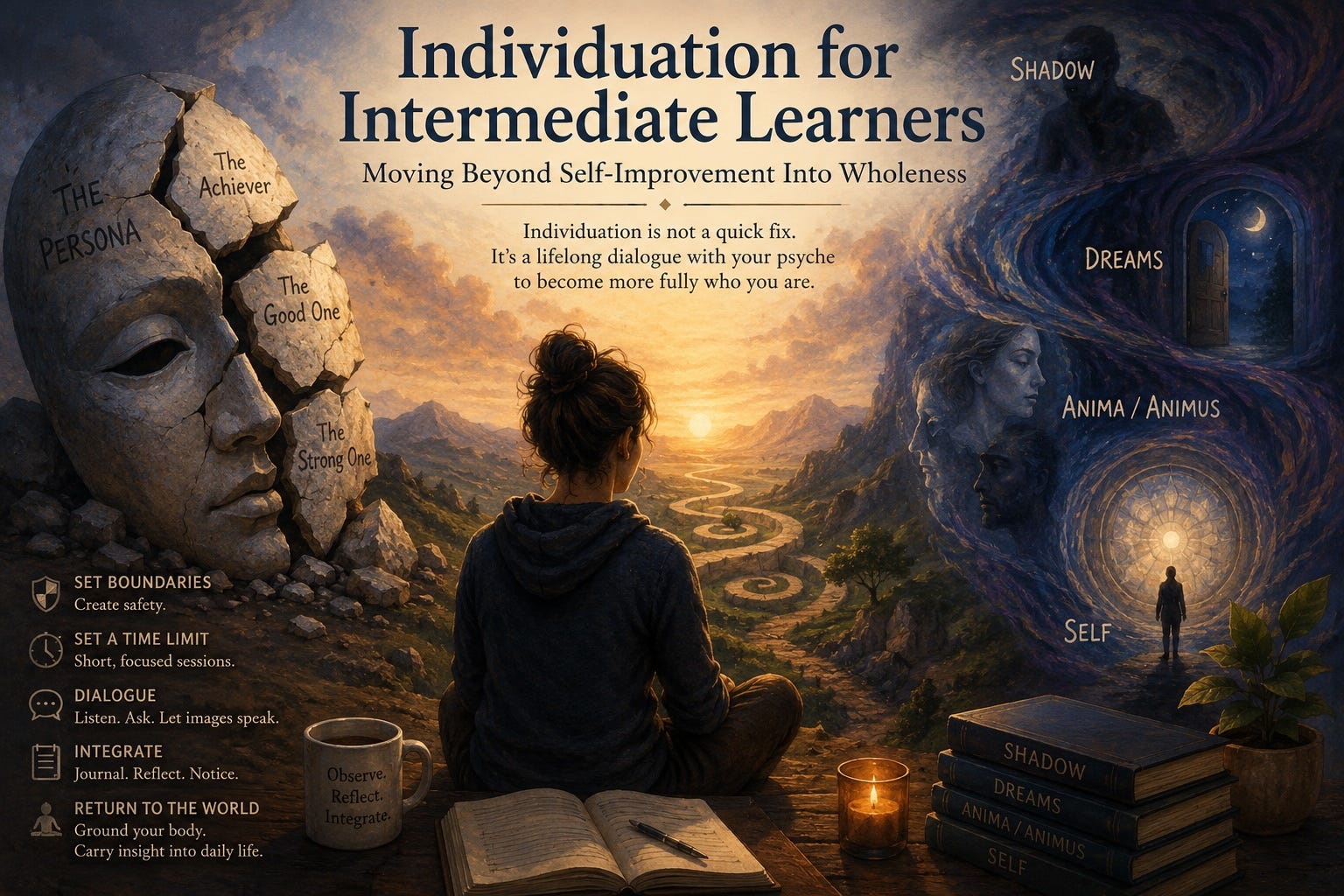
WHAT INDIVIDUATION IS (AND ISN’T)
In everyday self-help, the implied goal is often a better “me”: more disciplined, more confident, more successful, more efficient. The method is usually linear: identify problem, apply technique, track progress, repeat. Even when the advice is compassionate, it frequently carries a subtle message: you are behind, and your worth will rise when you improve.
Individuation moves differently. It doesn’t reject growth, but it questions the premise that your value depends on constant upgrading. The goal is not to become an ideal persona—the polished version of you that performs well and earns approval. The goal is to become more whole, which includes parts of you that are inconvenient, tender, contradictory, or socially unmarketable.
That’s why individuation can feel “slower” than self-help. It doesn’t always give quick relief, because it’s not primarily symptom-focused. It’s relationship-focused: relationship to your shadow, to your anima/animus (the inner contrasexual or complementary psychic principle), to your personal history, to your body, to your creative life, to your spiritual questions, and ultimately to the Self—the deeper organizing principle of the psyche that is not identical with the ego.
A useful way to frame it: self-help often asks, “How do I become the person I want to be?” Individuation asks, “What is trying to become conscious through me?”
MOVING FROM OPTIMIZATION TO WHOLENESS
Productivity-style self-help tends to moralize inner states. If you’re anxious, you must reduce anxiety. If you’re unmotivated, you must hack motivation. If you’re conflicted, you must decide quickly and move forward. The psyche becomes a workplace with KPIs.
But the unconscious doesn’t speak in KPIs. It speaks in images, symptoms, dreams, fantasies, sudden attractions and aversions, repeating relational patterns, and the peculiar emotional weather that arrives “for no reason.” Individuation trains you to take these communications seriously—not as enemies to eliminate, but as messages to interpret.
Consider a common moment: you’ve been “doing everything right.” You’re exercising, meditating, working hard, staying positive. And then you feel oddly flat. Not depressed exactly—just dull, as if life has lost color. The self-help reflex is to add a new habit or double down on gratitude. The individuation reflex is to ask: What part of me has been excluded? What truth am I avoiding? What desire has been judged unworthy? What grief has been postponed?
Wholeness is not the same as happiness, and it’s not the same as constant peace. Wholeness is a deeper integrity. It can include sorrow, anger, longing, and limitation—without collapsing into them or denying them.
A MAP OF COMMON PHASES (NOT A CHECKLIST)
Individuation doesn’t unfold in a neat sequence for everyone, and it’s not a ladder you climb once. It’s more like a spiral: themes return at deeper levels. Still, intermediate learners often benefit from a rough map—especially when the work starts to feel confusing.
PHASE 1: THE PERSONA CRACKS
This phase often begins with success that doesn’t satisfy, or a crisis that exposes the limits of your usual identity. The persona is the social mask: the role you learned to play to belong and to survive. It isn’t “fake” in a simple sense; it’s adaptive. But it becomes a problem when you confuse it with your whole self.
Inner tensions that signal growth here:
You feel exhausted by being “the responsible one,” “the good one,” “the strong one,” “the achiever.”
You notice a private resentment toward the very identity you’ve built.
You feel like you’re living someone else’s life, even if it looks good from the outside.
A short anecdote: A competent manager in her thirties prided herself on calm leadership. She was the one everyone leaned on. Then she began having dreams of missing trains and arriving late, hair undone, papers scattered. In waking life she became increasingly irritated by small requests. The dream wasn’t telling her to become less competent; it was revealing the cost of a persona that had no room for need, mess, or dependency. Her irritation was not a flaw to optimize away—it was a signal that another part of her needed a voice.
PHASE 2: SHADOW CONTACT (AND THE MORAL HANGOVER)
When the persona loosens, the shadow appears more clearly. The shadow is not only “badness.” It is everything you have disowned: aggression, vulnerability, envy, sensuality, ambition, grief, tenderness, spiritual hunger, playfulness—whatever didn’t fit your self-image or your family’s expectations.
Inner tensions that signal growth here:
You feel shame about thoughts or impulses you “shouldn’t” have.
You become preoccupied with what annoys you in others.
You feel a sudden attraction to experiences you used to judge.
You swing between self-condemnation and justification.
This is where productivity-self-help can become a trap. If your goal is to be “high vibe” or endlessly composed, you’ll treat shadow material as failure. Individuation treats it as raw material.
A practical example: You keep getting irritated at a friend who “always makes it about them.” Eventually you admit: part of you envies their self-focus. You’ve been trained to be accommodating, to disappear. The shadow isn’t telling you to become selfish; it’s telling you to develop rightful self-regard and boundaries. The irritation was a messenger.
PHASE 3: ANIMA/ANIMUS AND THE PROJECTION STORM
At a certain point, relationships become the main theater of individuation. You fall in love, you idolize, you despise, you feel magnetized or repelled beyond reason. Often this is projection: inner figures are seen “out there” in another person.
Inner tensions that signal growth here:
You feel addicted to someone’s approval or attention.
You oscillate between idealization and disappointment.
You feel irrational jealousy or possessiveness.
You sense that your reactions are “too big” for the situation.
Projection is not something to eliminate with willpower; it’s something to retrieve with humility. The question becomes: What quality am I encountering in them that wants to live in me?
A short anecdote: A man repeatedly dated partners he described as “free spirits.” At first he adored their spontaneity; later he resented their unpredictability. Over time he realized he had exiled his own spontaneity into the shadow. He was living as a dutiful provider, terrified of being irresponsible. His partners carried the missing piece. Individuation didn’t mean becoming chaotic; it meant making room for play, risk, and creative movement so he didn’t need someone else to carry it for him.
PHASE 4: THE DEADLOCK OF OPPOSITES
This is where intermediate learners often feel stuck. You’ve done real work. You see your patterns. You can name your defenses. And yet you face choices that cannot be solved by insight alone. You want two incompatible things. You feel pulled between security and freedom, intimacy and autonomy, ambition and simplicity, loyalty and truth.
Inner tensions that signal growth here:
You feel a persistent “either/or” pressure, and neither option feels clean.
You experience fatigue from constant self-analysis.
You notice a longing for something you can’t rationally justify.
You sense an inner authority emerging that doesn’t match external expectations.
In Jungian terms, this phase often requires tolerating the tension of opposites until a third thing emerges: a symbol, a new attitude, a creative solution that isn’t a compromise but a transformation. This is not a productivity hack. It’s a psychological gestation.
PHASE 5: A DEEPER CENTER (LIVING FROM THE SELF)
Over time, the ego becomes less of a tyrant and more of a steward. You still have preferences and goals, but you’re less possessed by them. You begin to recognize when you’re acting from persona, when you’re acting from fear, and when you’re aligned with something quieter and truer.
Inner tensions that signal growth here:
You feel less interested in impressing and more interested in being honest.
You can disappoint others without collapsing into guilt.
You grieve more cleanly, without turning grief into self-hatred.
You feel called toward work or relationships that are less glamorous but more real.
This phase isn’t perfection. It’s a different kind of responsibility: not “How do I look?” but “What is asked of me?” Not constant self-critique, but ongoing self-accountability.
THE INNER TENSIONS THAT MEAN YOU’RE ON TRACK
Individuation often feels like losing certainty before gaining wisdom. If you’re used to self-help that promises clarity and control, this can feel like regression. But certain tensions are classic signs of growth:
1) Increased complexity: You can see multiple sides of yourself without rushing to label one as “the real me.”
2) More honest emotion: Feelings become less performative and more informative.
3) Reduced projection: You still get triggered, but you recover faster and ask better questions.
4) A new relationship to time: You stop demanding that your psyche produce immediate results.
5) A shift from image to integrity: You care more about inner alignment than external metrics.
The paradox is that individuation can make you less “optimized” and more alive. You may become harder to categorize. You may change your mind. You may choose differently than your old persona would have allowed. That’s not backsliding; it’s differentiation.
CONCLUDING TAKEAWAY
Individuation is not a weekend makeover of the psyche. It’s a long apprenticeship in becoming whole. The work is not to eradicate inner conflict, but to listen for what conflict is trying to reveal. When you stop treating symptoms as enemies and start treating them as symbolic communications, your life becomes less about fixing yourself and more about meeting yourself—again and again, at deeper levels.
If you want a simple compass for intermediate practice, try this: whenever you feel stuck, ashamed, obsessed, or unusually reactive, ask what part of you is asking to be included. Not indulged. Included. That one shift—from improvement to inclusion—quietly changes everything.