Jungian Archetypes 101: The Self, Shadow, Hero, and Trickster in Daily Life
You don’t need to believe in “types” of people to notice something curious: the same inner dramas repeat across different days, different relationships, even different decades. One morning you feel brave and purposeful, like you could finally do the hard thing. By afternoon you’re avoiding an email, snapping at someone you love, or drifting into distraction. Then, out of nowhere, you laugh at yourself and the tension breaks—only to return later in a new disguise. Jungian psychology offers a simple, surprisingly practical way to map these repeating patterns without turning you into a caricature.
Thanks for reading! Subscribe for free to receive new posts and support my work.
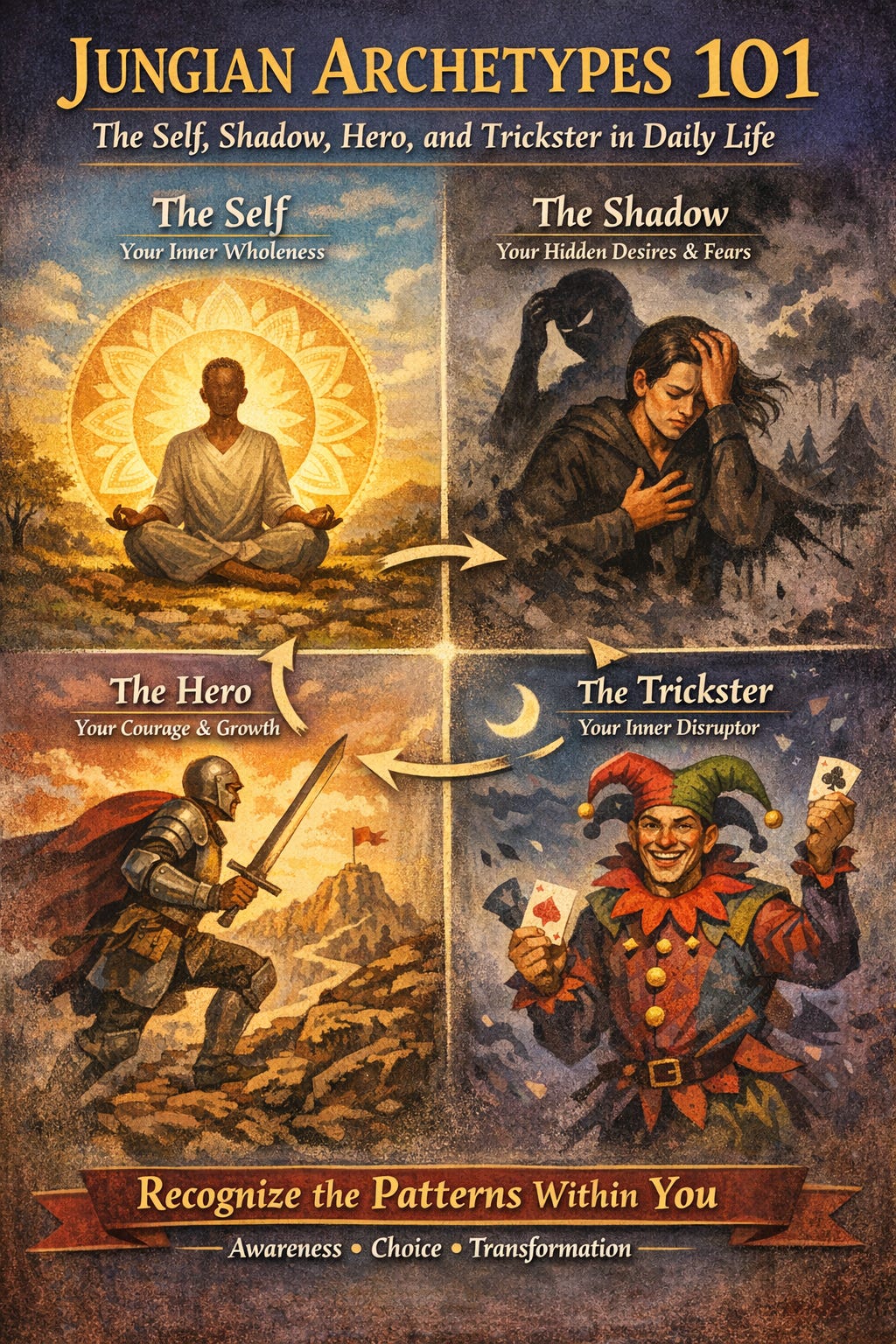
Here’s the thesis: Jungian archetypes are not rigid personalities or mystical labels; they’re universal pattern-shapes in the psyche that show up in emotions, habits, and stories. When you learn to recognize a few key archetypes—especially the Self, Shadow, Hero, and Trickster—you gain a language for self-reflection that can reduce shame, increase choice, and deepen your sense of meaning. The goal is not to “be” an archetype, but to notice when an archetypal energy is running the show.
THE BASIC IDEA: ARCHETYPES AS PATTERNS, NOT FORTUNE-TELLING
In everyday terms, an archetype is like a recurring script your mind knows how to run. It comes with typical feelings, images, impulses, and storylines. You can see these scripts in dreams, in the roles we fall into with family, in the kinds of movies we rewatch, and in the predictable ways we react under stress.
A common beginner’s mistake is to over-literalize archetypes: “I am a Hero,” “My partner is a Trickster,” “My boss is my Shadow.” That turns a tool for reflection into a rigid identity or a way to blame others. A better approach is to treat archetypes as weather patterns in the inner world. You don’t “become” a thunderstorm, but you can notice when one is moving in, understand its typical effects, and choose how to respond.
Archetypes also aren’t moral categories. “Shadow” doesn’t mean “evil.” “Hero” doesn’t always mean “good.” Each archetype has a healthy expression, a distorted expression, and a reason it exists. The work is to recognize the pattern early enough to relate to it consciously.
THE SELF: THE INNER CENTER THAT HOLDS THE OPPOSITES
In Jungian thought, the Self is the organizing principle of the whole psyche—the “center” that is larger than the ego. If the ego is the part of you that says “I am this kind of person,” the Self is the deeper intelligence that keeps nudging you toward wholeness, including the parts you’d rather ignore. People sometimes confuse the Self with self-esteem or a calm mood. The Self is more like an inner compass.
How it shows up in daily life:
You can often sense the Self when you feel pulled toward something that’s both challenging and meaningful. It might look like an urge to tell the truth, to stop performing, to make a decision you’ve been postponing, or to create something that feels “more like you.” It can also show up as discomfort when you’re living out of alignment—restlessness, a vague sadness, the sense that you’re playing a role.
A short anecdote: Imagine someone who has built a life around being “the reliable one.” They say yes to everything, keep the peace, never make demands. On paper, it looks admirable. But they begin having a recurring dream: they’re in a house with many rooms, and one locked door they can’t stop thinking about. In waking life, they keep feeling irritated for “no reason.” From a Jungian lens, the Self might be pressing for a fuller life—one that includes needs, boundaries, maybe even anger. The locked room isn’t a prophecy; it’s a symbol of unlived life.
A practical way to recognize the Self:
Notice what repeatedly returns as meaningful, even when it’s inconvenient. Also notice what brings a quiet sense of “rightness” that isn’t the same as pleasure. The Self often speaks through symbols, synchronicities (in the loose sense of meaningful coincidence), and the persistent feeling that a certain path is yours—even if you can’t justify it neatly.
THE SHADOW: WHAT YOU DON’T WANT TO BE (AND WHAT YOU’RE AFRAID TO WANT)
The Shadow is the set of traits, desires, emotions, and potentials that the ego rejects or disowns. It forms partly from personal history (what got you punished or shamed) and partly from cultural expectations (what your environment labels unacceptable). The Shadow isn’t only “dark.” It can include positive qualities you learned to hide: confidence, sensuality, ambition, playfulness, tenderness, leadership.
How it shows up in daily life:
Shadow material often leaks out through overreactions, compulsions, projections, and “why did I say that?” moments. If you find yourself intensely bothered by a trait in someone else, it can be a clue—not always, but often. The question isn’t “Am I exactly like them?” It’s “What is this reaction trying to show me about what I’ve disowned?”
Everyday examples:
If you pride yourself on being easygoing, you might have a shadow of anger. It may appear as passive aggression, sarcasm, or a sudden blow-up that surprises even you. If you pride yourself on being independent, you might have a shadow of need. It can show up as contempt for “needy people,” or as repeated relationships where you choose partners who need you so you never have to admit you need them too.
A short anecdote: Someone insists they “never get jealous.” Yet they feel a spike of disgust when a friend shares good news. They immediately judge the friend as “showing off.” Later, they feel guilty and confused. A shadow-aware reading might be: envy is present, and underneath envy is a disowned desire—“I want that too.” The growth edge isn’t to shame the envy away; it’s to listen for the desire, and to grieve what feels out of reach, then choose a next step.
A practical way to work with Shadow without overdoing it:
Start small and specific. When you have a strong reaction, ask: What exactly am I reacting to? What am I afraid it says about me? What would it mean if I had a tiny version of this trait? Then find a safe, bounded way to integrate it. If the shadow is anger, integration might be learning to say a clear no. If it’s need, integration might be asking for support once, without apologizing for existing.
THE HERO: THE PART THAT GOES FORTH, STRUGGLES, AND GROWS
The Hero archetype is the energy of courage, effort, and initiation. It’s the part of the psyche that says, “I will try,” and tolerates the discomfort of growth. In myth, the Hero leaves the familiar world, faces trials, gains something valuable, and returns changed. In daily life, that can look like learning a skill, healing a pattern, starting therapy, ending an unhealthy relationship, or simply having a difficult conversation.
How it shows up in daily life:
You can feel Hero energy as a clean, forward-moving determination. It’s not always loud. Sometimes it’s quiet persistence: showing up again, practicing again, telling the truth again. But Hero energy has a shadow side too. When inflated, it becomes the savior complex, the grind, the identity of “I must overcome everything.” Then life turns into a constant battle, and rest feels like failure.
A short anecdote: Someone decides to finally change their relationship with alcohol, social media, or late-night snacking. The first week, they feel heroic—motivated, disciplined, proud. The second week, they slip. If their Hero is inflated, they interpret the slip as proof they’re “weak” and either punish themselves or give up. A more integrated Hero recognizes that setbacks are part of the journey. The real heroism might be returning to the path without self-violence.
A practical way to recognize healthy Hero energy:
Ask whether your effort is connected to a value, not just to proving yourself. Healthy Hero energy serves the Self (wholeness). Inflated Hero energy serves the ego (image). One clue: if your inner dialogue sounds like a drill sergeant, the Hero may be wearing armor that’s too heavy.
THE TRICKSTER: THE DISRUPTER, THE JOKER, THE AGENT OF CHANGE
The Trickster archetype breaks rules, exposes hypocrisy, and disrupts rigid structures. Trickster energy can be playful and freeing, or chaotic and undermining. It’s the part of the psyche that refuses to let you stay too certain, too righteous, too stuck. In stories, the Trickster steals fire, tells jokes, makes messes, and sometimes accidentally creates something new.
How it shows up in daily life:
Trickster appears in slips of the tongue, unexpected laughter, procrastination, ironic reversals, and moments when the psyche “sabotages” an overcontrolled plan. It can also show up as the inner comedian who punctures perfectionism. But it can become destructive when it turns into chronic avoidance, manipulation, or a refusal to commit.
Everyday examples:
You decide to start meditating every morning, but on day three you oversleep and spill coffee on your shirt. You feel ridiculous. Then you laugh, and the perfectionism loosens. That’s Trickster as medicine. Or: you keep “accidentally” flirting when you’ve promised yourself you’ll be honest in your relationship. That may be Trickster as avoidance—dodging responsibility by turning everything into a game.
A short anecdote: Someone prides themselves on being purely rational. They dismiss feelings as “messy.” Then they fall in love with a person who makes no sense on paper. They try to logic their way out of it, and the more they resist, the stronger it gets. The Trickster may be at work, not to ruin their life, but to challenge an identity that has become too narrow. The invitation isn’t to abandon reason; it’s to make room for the irrational parts of being human.
A practical way to work with Trickster:
When something derails your plan, ask: Is this disruption revealing a rigid belief? Is there a truth trying to surface? Then decide consciously. Sometimes the answer is to recommit with flexibility. Sometimes it’s to change the plan because the old one was more about control than about life.
PUTTING IT TOGETHER: RECOGNIZING ARCHETYPES IN EMOTIONS, HABITS, AND STORIES
A simple way to use this map is to notice which “story” you’re living in a given moment.
If you’re feeling a pull toward meaning, a sense of inner alignment, or a persistent symbol that won’t leave you alone, you may be near the Self.
If you’re having an outsized reaction, a repetitive conflict, or a strong urge to judge someone, the Shadow may be asking for attention.
If you’re taking on a challenge, facing fear, or trying again after a setback, the Hero is online.
If you’re caught in irony, disruption, avoidance, or liberating laughter, Trickster energy is present.
You don’t need to pick one. Often they come in sequences. The Self calls you toward growth, the Hero steps up, the Shadow resists, and the Trickster disrupts the rigidity of your approach—ideally helping you find a more honest way forward.
CONCLUDING TAKEAWAY
The point of archetypes isn’t to label yourself; it’s to develop a relationship with your inner patterns. When you can say, “Ah, this feels like Shadow,” you create a small gap between impulse and action. When you can sense the Self—quiet, steady, insistent—you can choose growth that’s rooted in wholeness rather than performance. When the Hero shows up, you can let it serve your values instead of your ego. And when the Trickster arrives, you can ask whether it’s offering medicine or merely noise.
If you want a gentle way to explore these patterns, try tracking one moment per day when you felt strongly activated—angry, ashamed, inspired, compelled, amused. Write what happened, what story you told yourself, and which archetypal energy might have been in the room. Over time, the patterns become easier to recognize, and the psyche becomes less of a mystery and more of a conversation.
Optional CTA: Subscribe if you want more beginner-friendly Jungian maps and reflective prompts you can use in real life—especially if you’re curious about shadow work that stays grounded, practical, and human.
Thanks for reading! Subscribe for free to receive new posts and support my work.