If you’ve been doing shadow work for a while, you’ve probably had this experience: you journal intensely, you cry or feel a rush of honesty, you write a few brave sentences you never would’ve admitted a year ago… and then a week later you’re back in the same loop. The entry was “true,” but it didn’t move anything. Catharsis happened, insight flickered, and yet your behavior, your relationships, your triggers, your self-sabotage—oddly unchanged. That’s not a failure of sincerity. It’s often a failure of structure.
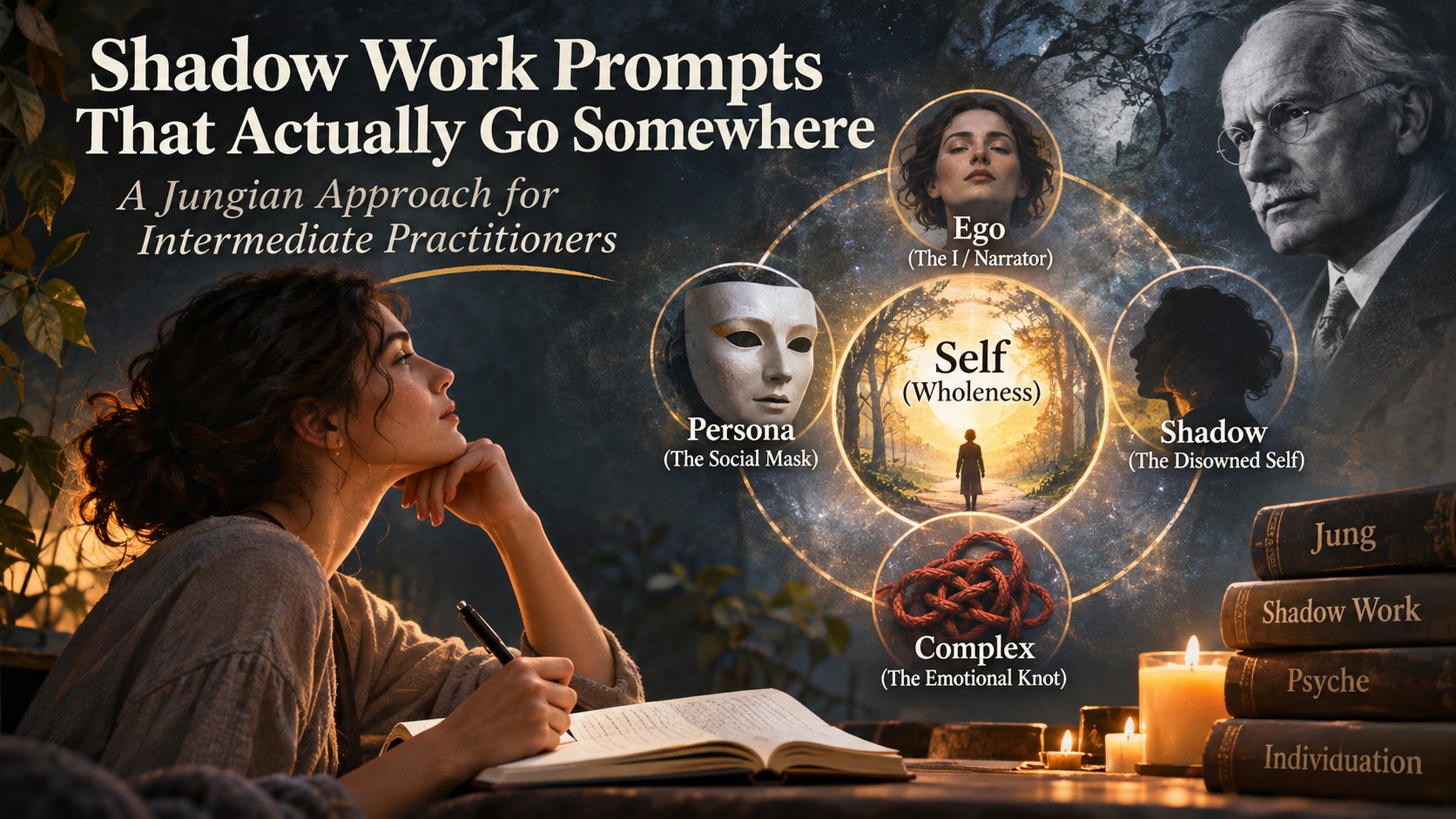
Here’s the thesis: shadow work becomes transformative when your prompts are organized around Jung’s model of the psyche—ego, shadow, persona, complexes, and the Self—so that your journaling doesn’t just express emotion, but maps the inner system that generates it. When you can locate where an experience lives in the psyche, you can negotiate with it, integrate it, and stop repeating it.
WHY “GOOD PROMPTS” OFTEN STALL OUT
Generic prompts tend to collapse very different inner phenomena into one bucket. “What am I avoiding?” could be avoidance driven by persona maintenance (image management), a complex (a charged cluster of memories and meanings), a shadow trait (disowned aggression), or a legitimate boundary (your psyche refusing an unaligned path). Without distinguishing which is which, you can produce pages of self-knowledge that is psychologically accurate but operationally useless.
A Jungian approach treats your inner life like an ecosystem. Different parts have different motives. The ego wants coherence and control. The persona wants belonging and approval. The shadow wants recognition and energy. Complexes want repetition until they are made conscious. The Self wants wholeness, which often looks like disruption before it looks like peace. Prompts that “go somewhere” help you identify which voice you’re hearing, what it wants, and what it’s protecting.
THE MAP: EGO, PERSONA, SHADOW, COMPLEX, SELF
Think of ego as the “I” that narrates your life. Persona is the social mask that helps you function in groups. Shadow is what you’ve disowned or underdeveloped—traits, impulses, capacities, even gifts—because they didn’t fit your identity or environment. A complex is a knot of emotion and memory that hijacks you with disproportionate intensity. The Self, in Jung’s sense, is the organizing center of the whole psyche, the pull toward integration.
Intermediate shadow workers often have no trouble naming shadow content in the abstract. The sticking point is differentiation: Is this anger shadow anger (disowned power)? Or complex anger (old humiliation replaying)? Is this “people-pleasing” persona? Or a survival strategy that once kept you safe? The prompts below are designed to sort that out.
PERSONA CHECK: WHEN THE MASK IS DOING THE DRIVING
The persona isn’t “fake.” It’s functional. But when it becomes rigid, it starts costing you vitality. A persona-driven life often feels strangely performative, even in private—like you’re always slightly auditioning.
Prompt set:
When do I feel the need to be “easy,” “impressive,” “low-maintenance,” or “the strong one”? What am I afraid would happen if I stopped?
Which compliment do I secretly need, and what does that reveal about the role I’m playing?
What part of me do I edit out first in new relationships? What do I assume people can’t handle?
If my persona had a job title, what would it be? What is its KPI—approval, safety, admiration, control?
Example:
A practitioner notices she becomes “the competent one” in every group project. She journals about resentment and concludes, “I’m surrounded by incompetence.” Persona work reframes it: her competence-mask prevents her from asking for help, which would risk looking ordinary. The prompt “What am I afraid would happen if I stopped?” reveals a deeper fear: if she’s not useful, she’s not lovable. That’s not just a thought; it’s an organizing principle. Now the work “goes somewhere”: she can experiment with small acts of non-heroism and watch what anxiety arises.
SHADOW IDENTIFICATION: WHAT YOU DISOWNED (AND WHAT YOU ENVY)
One of the cleanest ways to find shadow material is through disproportionate reaction: intense disgust, moralizing, fascination, or envy. The shadow is not only “bad.” It includes unlived life—your unused assertiveness, sensuality, ambition, tenderness, creativity, even spirituality.
Prompt set:
Who irritates me in a way that feels personal? List their traits without explanation. Which of those traits do I forbid in myself?
What do I envy that I call “cringe,” “shallow,” “selfish,” or “attention-seeking”? What might be the healthy version of that trait?
If I allowed myself 10% more of the trait I judge, what would improve in my life? What would get worse?
What do I do “by accident” when I’m tired, stressed, or slightly intoxicated? What does that reveal about what’s been held down?
Short anecdote:
A man can’t stand “needy people.” He prides himself on self-sufficiency and becomes cold when partners want reassurance. Using the envy prompt, he realizes he secretly envies people who can ask directly for care. His shadow isn’t “neediness” as manipulation; it’s the capacity to receive. The integration move isn’t to become dependent. It’s to permit honest bids for connection without shame. The shadow trait, once owned, becomes a skill.
COMPLEX WORK: FIND THE TRIGGER’S AGE
Complexes are where shadow work becomes surgical. A complex has a story, a mood, a body sensation, and an internal logic. When it’s activated, you feel younger, smaller, more desperate, more righteous, or more helpless than the situation warrants. The goal is not to “get rid of” the complex, but to relate to it consciously so it stops driving blindly.
Prompt set:
What situation recently produced an emotional reaction that was bigger than the facts? Describe the facts like a camera would.
If this feeling had an age, what age is it? What does that younger part believe is about to happen?
What is the complex’s core sentence? (Examples: “I’m not chosen.” “I’ll be humiliated.” “I have to earn love.” “People leave.”)
What does this complex make me do to prevent pain? How does that strategy create the very outcome I fear?
Example:
Someone receives a short text reply and spirals into certainty they’re being rejected. The camera-facts are simple: “They replied with one word.” The feeling-age is 14. The core sentence is “I’m embarrassing.” The strategy is over-explaining, double-texting, and then resenting. Seeing the complex’s loop creates choice: pause, name the 14-year-old fear, and take one grounded action (wait, ask directly, or self-soothe) instead of performing the complex’s ritual.
A crucial intermediate move: don’t argue with the complex. Interview it. Complexes don’t respond well to being corrected; they respond to being understood and updated through lived experience.
EGO AND RESPONSIBILITY: INTEGRATION IS NOT INDULGENCE
Shadow work can accidentally become a way to excuse behavior: “That’s my shadow.” Jungian integration is the opposite. It increases responsibility because you can no longer pretend you “didn’t know” what was operating.
Prompt set:
What do I keep calling “a pattern” that is actually a choice I’m making repeatedly?
Where do I use insight as a substitute for action?
What am I afraid I’ll become if I accept this shadow trait? What boundary would keep it healthy?
What would accountability look like that is firm but not shaming?
Example:
A person recognizes a shadow of aggression and immediately fears becoming cruel. The boundary prompt helps: aggression can be channeled into clear “no,” decisive action, protecting time, defending values. The ego’s role is to steward the energy, not repress it or unleash it.
THE SELF’S PERSPECTIVE: WHAT IS TRYING TO EMERGE?
In Jungian terms, the Self is the deeper organizing intelligence that pushes you toward wholeness. Sometimes it speaks through symptoms: boredom, recurring conflict, dreamlike repetition, or a strange sense that your old identity doesn’t fit. Intermediate practitioners often sense this but keep trying to “fix” themselves back into an outdated persona.
Prompt set:
If I assume this struggle is meaningful (not just annoying), what might it be asking me to develop?
What part of my life feels over-identified—too tight, too certain, too “this is who I am”?
What is trying to be born in me that would threaten my current belonging?
If I stopped trying to be a “good” version of myself, what more truthful version appears?
Short anecdote:
A longtime “helper” begins feeling numb with clients and friends. She panics: “I’m losing my empathy.” From the Self’s perspective, numbness may be a signal that her psyche needs differentiation—limits, solitude, and a life not built around being needed. The emerging wholeness includes care and distance, love and boundaries. The symptom becomes a message, not a moral failure.
PUTTING IT TOGETHER: A THREE-PASS PROCESS THAT CREATES MOVEMENT
When you sit down to journal, try running your experience through three passes:
First pass (persona): What role was I trying to maintain? What image was I protecting?
Second pass (shadow/complex): What trait or fear got activated? How old does it feel? What’s the core sentence?
Third pass (integration): What would a small, specific action look like that honors the truth without acting it out?
This is how shadow work stops being only expressive and becomes developmental. You’re not just venting. You’re locating the psychic mechanism and practicing a new response.
CONCLUDING TAKEAWAY
Shadow work “goes somewhere” when it stops asking only, “What do I feel?” and starts asking, “Which part of the psyche is speaking, what does it want, and what is it protecting?” Jung’s model gives you a diagnostic lens: persona shows you where you’re performing, shadow shows you what you’ve disowned, complexes show you where you’re time-traveling, and the Self shows you what your life is trying to become.
The goal isn’t to achieve a permanently enlightened mood. It’s to increase your capacity to stay conscious at the exact moment you usually go automatic. That’s integration in real time: not perfect, but progressively freer.
If you want to keep practicing with structure, subscribe if you like prompts that are psychologically precise and designed to produce real inner movement—not just another intense journal entry. And if you ever want a guided space to explore these parts with reflective dialogue, Jungian Psyche Ai is built for exactly this kind of depth work, one conversation at a time.