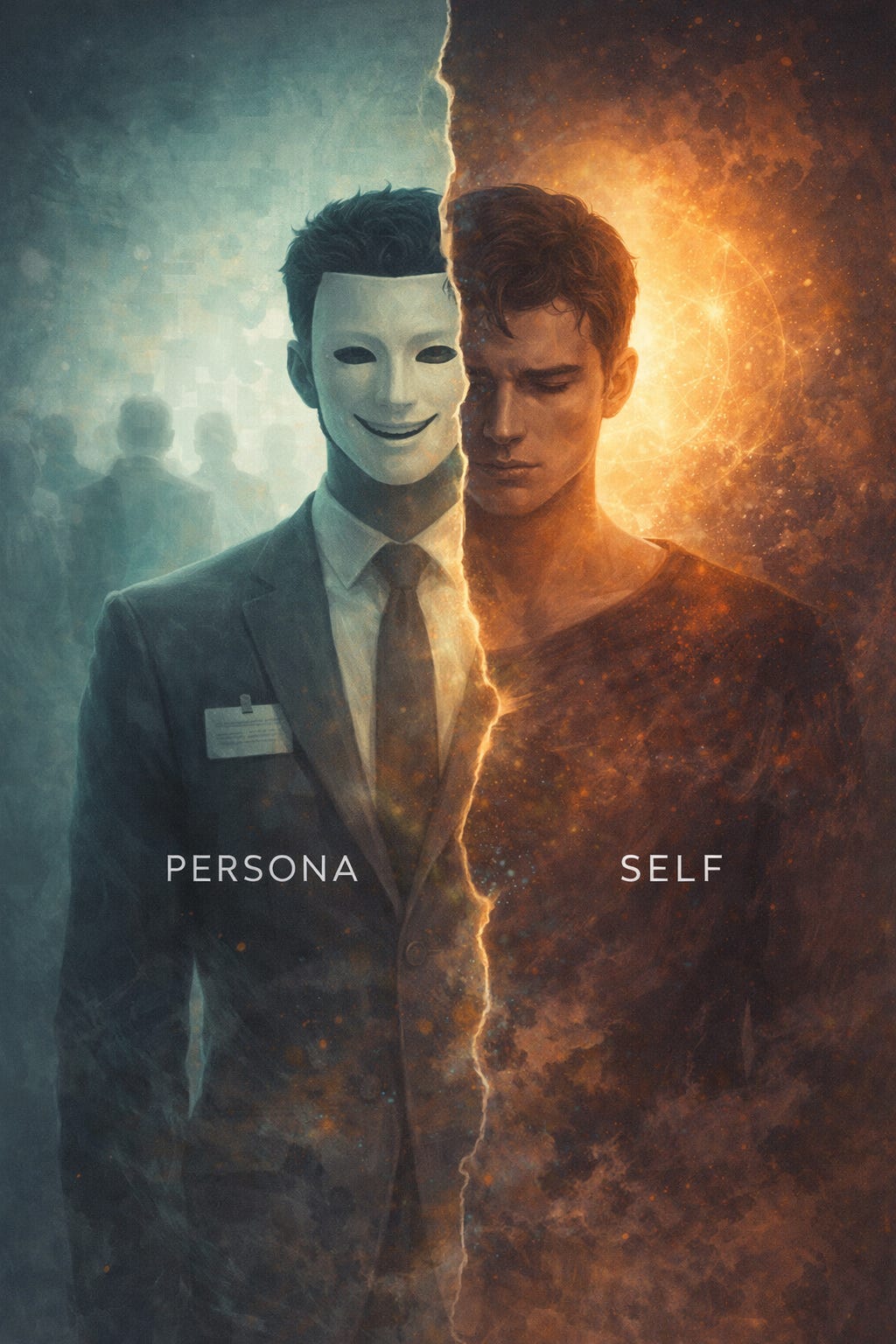
You can be doing everything “right” and still feel like a fraud. The meeting goes well, you say the correct things, people laugh at your jokes, you hit the milestones you’re supposed to hit—and then, when you’re alone, a strange hollowness creeps in. It’s not exactly sadness. It’s more like a quiet suspicion: If they really knew me, would they still approve? Or worse: Do I even know me?
Here’s the thesis: In Jungian psychology, that “fake” feeling often comes from over-identifying with the persona—your socially adapted mask—while losing contact with the Self, the deeper organizing center of your psyche. The persona is necessary and even healthy, but when it becomes your whole identity, life can start to feel like a performance without a performer.
WHAT JUNG MEANT BY “PERSONA”
Jung used the word persona to describe the face we present to the world: the role, the style, the tone, the set of behaviors that helps us belong. It’s the “professional you” at work, the “easygoing you” at a party, the “capable you” with your family. The persona isn’t inherently false. It’s functional. It’s how a complex inner life becomes legible in a social setting.
If you’ve ever moved to a new city, started a new job, or joined a new group, you’ve watched yourself assemble a persona in real time. You notice what’s rewarded, what’s frowned upon, what’s confusing to others, and you adjust. This is not hypocrisy; it’s adaptation. Without a persona, we’d be too raw, too private, too complicated to coordinate with anyone. Society requires a workable interface.
The trouble begins when the interface becomes the identity.
WHY THE PERSONA FEELS SO SAFE (AND SO EXHAUSTING)
The persona offers safety through predictability. If you’re “the responsible one,” you know what to do: be reliable, anticipate needs, keep things under control. If you’re “the funny one,” you know how to earn belonging: keep the mood light, never let silence linger, turn discomfort into a joke. Personas reduce social uncertainty. They also reduce inner complexity.
But what keeps you safe can also keep you trapped. A persona is built on repetition: you do what works, again and again, until it becomes automatic. Over time, you might stop asking, “What do I actually feel?” and start asking only, “What’s expected of me?” That’s when exhaustion sets in—not only from doing too much, but from being too consistent.
A short example: someone who becomes known as “the competent high-achiever” may find that even rest starts to feel like a violation. Their nervous system doesn’t just want to succeed; it wants to maintain the image of someone who always succeeds. If they struggle, they don’t experience it as a human moment. They experience it as identity collapse.
This is one root of imposter syndrome: not simply doubting your abilities, but fearing exposure because your persona has become a fragile shell you must constantly protect.
THE SELF IS NOT A PERSONALITY BRAND
When Jung speaks of the Self, he doesn’t mean the ego’s self-image (“I’m independent,” “I’m shy,” “I’m ambitious”). The Self is more like the psyche’s deeper center and totality—the organizing principle that includes conscious and unconscious life. It’s what you are becoming when you’re not merely reacting, performing, or conforming.
The ego is the “I” that navigates daily life. The persona is the ego’s social mask. The Self is larger than both. It includes your contradictions, your unlived potentials, your inconvenient feelings, your tenderness, your aggression, your creativity, your grief—everything that belongs to your wholeness.
So when people say they want to “be themselves,” they often mean, “I want to feel real.” In Jungian terms, feeling real tends to arise when ego and persona are in a respectful relationship with the Self—when the mask is worn lightly and the inner life is not abandoned.
WHEN THE PERSONA TAKES OVER: SIGNS YOU’VE OVER-IDENTIFIED
Over-identification with the persona doesn’t always look like vanity or superficiality. Often it looks like virtue. You become the caretaker, the peacemaker, the spiritual one, the rational one, the productive one. People praise you. You get rewarded. And yet something in you quietly starves.
Here are a few common signs, described in everyday language:
You feel strangely empty after social success. Compliments land, but they don’t nourish.
You feel anxious when you’re not “on.” Silence, rest, or not knowing what to say feels threatening.
You feel you must maintain a consistent image, even with people close to you.
You feel resentment toward those who “get to be messy,” while you must be composed.
You feel a private fear of being found out, even when you’re competent.
You don’t know what you want until someone else wants something from you.
None of these prove anything on their own. But together they can point to a psyche that has invested too much energy in being seen a certain way, and too little in being in contact with what is actually true inside.
THE SHADOW: WHAT THE PERSONA PUSHES AWAY
In Jungian psychology, the shadow is what the conscious personality rejects or disowns. The persona and the shadow are often paired: the brighter and more polished the persona becomes, the more material gets pushed into the shadow.
If your persona is “nice,” your shadow may contain anger, firmness, selfishness, or the capacity to disappoint people. If your persona is “strong,” your shadow may contain vulnerability, need, dependency, and grief. If your persona is “low-maintenance,” your shadow may contain longing, desire, and the wish to be cared for.
This is where “feeling fake” becomes psychologically meaningful. The psyche knows what has been excluded. Even if you can’t name it, some part of you senses the gap between the role and the whole person. The fake feeling is not a moral indictment; it’s a signal. It says: Something wants to be included.
A brief anecdote: imagine someone who has built a persona as the “calm, evolved communicator.” They pride themselves on never raising their voice, never being reactive. Then they find themselves snapping at a partner over something small—dishes, a late text, a tone of voice. The outburst shocks them: “That’s not me.” But from a Jungian view, it is them. It’s the disowned part finally demanding recognition. The work isn’t to shame the outburst or double down on the calm persona. The work is to ask: What has my calmness been protecting me from feeling?

Download Jungian Psyche Ai on the App Store

RECONNECTING WITH AUTHENTICITY WITHOUT BURNING DOWN YOUR LIFE
A common misunderstanding is that authenticity means removing the mask entirely. But you don’t need to reject social life or stop being competent, kind, or successful. Jung’s approach is more nuanced: differentiate from the persona without destroying it.
Think of it this way: the persona is a tool you use, not a place you live.
The goal is to wear your roles consciously. You can be professional without becoming only “the professional.” You can be helpful without becoming only “the helper.” You can be impressive without becoming only “the impressive one.”
What helps is building a private relationship with the Self—an inner space where you are not performing. This is why Jung valued practices that allow the unconscious to speak: dreams, active imagination, creative work, honest journaling, and reflective dialogue. These practices aren’t about self-improvement as branding. They’re about self-contact.
REFLECTIVE PROMPTS FOR PERSONA AND SELF
Try these prompts slowly. You don’t need perfect answers. You’re listening for what feels alive, uncomfortable, or oddly relieving.
Where do I feel most “on” in my life right now? What role am I playing there?
What do I fear would happen if I showed 10% more truth in that setting?
What part of me do I work hardest to hide? What does it want, and what is it protecting?
When do I feel most real? Not most admired—most real.
If I stopped trying to be impressive, what would I pay attention to instead?
What emotion do I consider unacceptable for me to feel (anger, need, envy, sadness, pride)? What experiences taught me that?
Who benefits from my persona? Who pays the cost?
What do I secretly envy in others? Envy often points to disowned potential.
If my “fake” feeling could speak, what would it say it needs?
As you reflect, notice the temptation to turn these into a performance too: “I must become authentic in the correct way.” That’s the persona sneaking back in. The Self is not impressed by your self-analysis. The Self wants honesty.
A PRACTICAL WAY TO START: THE “BOTH/AND” MOVE
A simple integration practice is to replace either/or identity statements with both/and statements.
Instead of: “I’m confident.” Try: “I can be confident, and I can be uncertain.”
Instead of: “I’m the responsible one.” Try: “I’m responsible, and I also need support.”
Instead of: “I’m easygoing.” Try: “I’m easygoing, and I also have preferences.”
Instead of: “I’m spiritual and above drama.” Try: “I value peace, and I also get angry.”
This “both/and” move loosens the persona’s grip. It gives the ego permission to be complex. Complexity is often what authenticity actually feels like.
CONCLUDING TAKEAWAY
If you feel fake, it doesn’t necessarily mean you’re dishonest. It may mean you’ve become too loyal to a role that once helped you belong. The persona is a necessary social mask, but it’s not meant to replace your inner life. Jung’s invitation is not to abandon the persona, but to relate to it consciously—while making room for the shadow and listening for the deeper movement of the Self.
When you do, the goal isn’t to become a perfectly authentic person who never performs. The goal is something quieter and more durable: to feel inwardly accompanied by yourself, even while you play your roles in the world.
If you want more reflections like this—grounded in Jungian ideas, shadow work, and practical inner dialogue—subscribe if that kind of self-understanding feels like the missing piece.