You can be doing everything “right” and still feel like a fraud. The meeting goes well, people laugh at your jokes, your friends say you’re thriving, your family is proud. And then, later—maybe in the quiet after the day ends—it hits: a hollow feeling, like you were performing a version of yourself rather than living as yourself. You might even wonder, Who am I when no one is watching?
Thesis: In Jungian psychology, that “fake” feeling often isn’t proof that you’re broken or dishonest—it’s a signal that your persona (your social mask) has become too tightly fused with your identity, while the deeper Self is asking for attention. The goal isn’t to throw away the persona and live as an unfiltered raw nerve. The goal is to relate to the persona consciously, so you can participate in social life without losing contact with your inner truth.
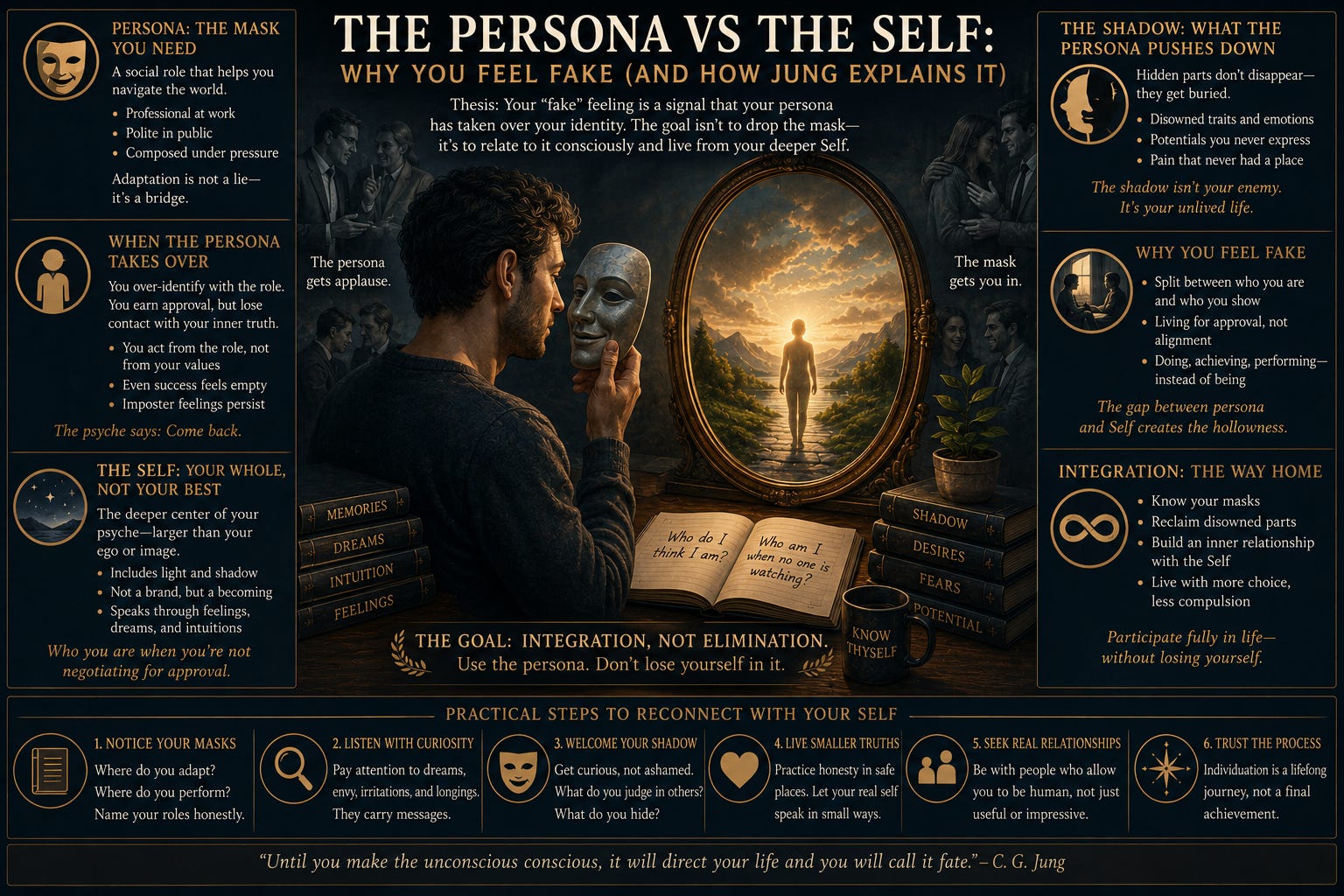
PERSONA: THE MASK YOU NEED (AND WHY IT EXISTS)
Carl Jung used the term persona to describe the face we present to the world. The word itself comes from the masks worn in ancient theater. That origin matters: a mask isn’t automatically a lie. A mask is a role that helps something be communicated.
In everyday life, the persona is what allows you to navigate society. It’s the part of you that knows how to be “professional” at work, “polite” at a neighbor’s party, “competent” in a new environment, “composed” when you’re anxious. Without some persona, you’d be constantly overwhelmed by the need to express every feeling and impulse in real time. You’d also be socially unreadable to others. The persona is a bridge between your inner world and the expectations of the outer world.
So if you’ve ever judged yourself for having a “work voice,” for being more charming at a party than you feel inside, or for curating what you share, Jung would likely say: of course you do. You’re a human being living among other human beings. Some adaptation is not only normal—it’s necessary.
The trouble begins when the persona stops being a tool and starts becoming a prison.
WHEN THE PERSONA TAKES OVER: THE QUIET RISE OF IMPOSTER FEELINGS
A persona becomes problematic when you over-identify with it—when you unconsciously treat the mask as your whole face.
This often happens gradually. You get rewarded for a certain version of yourself. Maybe you’re praised for being the “smart one,” the “strong one,” the “easygoing one,” the “successful one,” the “nice one,” the “spiritual one,” the “low-maintenance one.” That identity brings approval, safety, belonging. And because the psyche is intelligent in its own way, it learns: This is what works. This is what keeps me accepted.
Over time, you may stop asking what you actually want, feel, or believe, and start asking what the role requires. Your inner life becomes a backstage area you rarely enter. Eventually, even positive feedback can feel strangely empty—because it’s not landing on the real you, it’s landing on the persona.
This is one reason imposter syndrome can persist even when you’re competent. The psyche isn’t only concerned with performance. It’s concerned with wholeness. If you’re succeeding while abandoning parts of yourself, the success can feel unreal, like it doesn’t belong to you.
A short anecdote: imagine someone who is known as the “reliable achiever.” They meet every deadline, solve problems quickly, never complain. Everyone trusts them. But when they finally take a day off, they feel restless and vaguely panicked. Without the role of “capable one,” they don’t know who they are. That anxiety isn’t laziness or melodrama. It’s the psyche saying, You’ve been living as a function. Come back.
THE SELF: NOT YOUR “BEST SELF,” BUT YOUR WHOLE SELF
In Jungian terms, the Self is not the persona and not the ego’s self-image. The Self is the deeper organizing center of the psyche, the wholeness that includes what you know about yourself and what you don’t yet know. It’s bigger than your current identity.
This is crucial: the Self is not a brand. It’s not your “optimized” version. It includes your gifts and your contradictions, your tenderness and your anger, your longing and your fear, your spiritual aspirations and your human messiness. The Self is what you are becoming, not what you are performing.
If the persona is who you think you must be to belong, the Self is who you are when you’re not negotiating for approval.
But the Self doesn’t usually speak in neat sentences. It speaks in moods, dreams, sudden irritations, unexpected envy, recurring fantasies, and the feeling that something is missing even when life looks fine. Many people interpret those signals as personal failure. Jung would frame them as an invitation to individuation: the lifelong process of becoming more whole.
THE SHADOW: WHAT THE PERSONA PUSHES DOWN
The persona is selective. It highlights what’s acceptable and hides what might threaten belonging. What gets hidden often becomes part of the shadow: the traits, emotions, and potentials you’ve disowned.
If your persona is “always nice,” your shadow might contain anger, boundaries, and the capacity to disappoint others. If your persona is “always competent,” your shadow might contain vulnerability, uncertainty, the right to learn slowly, or the desire to be cared for. If your persona is “always chill,” your shadow might contain intensity, ambition, or deep sensitivity.
Feeling fake can be a sign that your shadow is pressing against the mask. Not to sabotage you, but to be included. The psyche doesn’t want you to become worse; it wants you to become more complete.
A simple example: someone prides themselves on being “the calm one” in relationships. They avoid conflict and keep things smooth. But they start feeling resentful and distant. Eventually they explode over something minor, shocking everyone—including themselves. From a Jungian view, the explosion isn’t random. It’s the shadow demanding a seat at the table. The authentic self isn’t only calm; it also has limits.
AUTHENTICITY WITHOUT SOCIAL SELF-DESTRUCTION
A common misunderstanding is that authenticity means removing the persona entirely: saying everything you think, expressing every emotion immediately, refusing any social adaptation. That’s not individuation; that’s impulsivity dressed up as honesty.
Jung’s approach is more nuanced. The persona is necessary. The aim is to hold it lightly, to know when you’re wearing it, and to let it be a role rather than a total identity. You don’t have to reject social life. You just need an inner relationship with yourself that isn’t dependent on applause.
Think of it like this: the persona is the outfit you wear to an occasion. The Self is your body. If you confuse the outfit for the body, you’ll panic when the outfit changes. If you remember the body, you can dress appropriately without losing your sense of reality.
REFLECTIVE PROMPTS: RECONNECTING WITH THE SELF
Try these prompts slowly. You don’t need perfect answers. You’re listening for emotional truth, not a polished narrative.
1) Where do I feel most “on” in my life right now?
Notice the environments where you perform. Work, family, dating, social media, certain friendships. What role are you playing there?
2) What do I fear would happen if I stopped playing that role?
Be honest. Would you lose approval? Would you disappoint someone? Would you feel exposed? This question often reveals the hidden bargain behind the persona.
3) What part of me is currently exiled?
Name what you’ve been pushing away. Anger, softness, ambition, grief, need, creativity, sensuality, spirituality, play. Don’t judge it. Just name it.
4) When do I feel quietly real?
Look for moments of low performance pressure: walking alone, making something, being with someone who doesn’t require you to impress them, reading, journaling, moving your body. What do those moments have in common?
5) What am I over-identified with?
Common answers: being helpful, being smart, being attractive, being productive, being moral, being “the strong one.” Ask: What do I do to maintain this identity? What does it cost?
6) If my persona could speak, what would it say it’s protecting me from?
Sometimes the persona is guarding an old wound: rejection, humiliation, chaos, abandonment. Thank it for its service. Then ask if it’s still the only strategy you have.
7) What is one small act of authenticity I can practice without burning down my life?
Not a dramatic confession. Something realistic. A boundary. A preference. A truth spoken gently. A creative risk taken privately. A rest day without justification.
A practical note: many people find it easier to do this kind of reflection with consistent prompts and a conversational mirror—something that helps you track patterns over time. Tools like Jungian Psyche Ai(iOS) (Web App) are designed to support exactly that: self-reflection informed by Jungian concepts, helping you notice your persona habits, shadow themes, and the deeper values trying to emerge. The value isn’t in “getting the right answer.” It’s in building an ongoing relationship with your inner world.
A SHORT PRACTICE: “MASK ON, MASK OFF”
Once a day, take two minutes and write two lines:
Mask on: Today I presented as ______.
Mask off: Underneath, I felt ______.
Over time, patterns appear. You’ll see where the gap is largest. That gap is often where the “fake” feeling lives—and where your growth wants to happen. The goal isn’t to eliminate the mask. It’s to reduce the gap by letting more of the inner truth have a voice.
CONCLUDING TAKEAWAY
Feeling fake isn’t necessarily a moral problem. Often it’s a psychological one: you’ve become too identified with the persona that helped you survive, succeed, or belong. Jung’s invitation is not to abandon society, but to stop confusing your social role with your soul. When you relate to the persona consciously, you can use it as intended—a flexible interface with the world—while staying rooted in the Self: the deeper wholeness that includes your shadow, your desires, your limits, and your real becoming.
If you want more reflections like this—grounded in Jungian psychology and practical shadow work—subscribe if you’re building a life that looks good on the outside, but you want it to feel true on the inside.