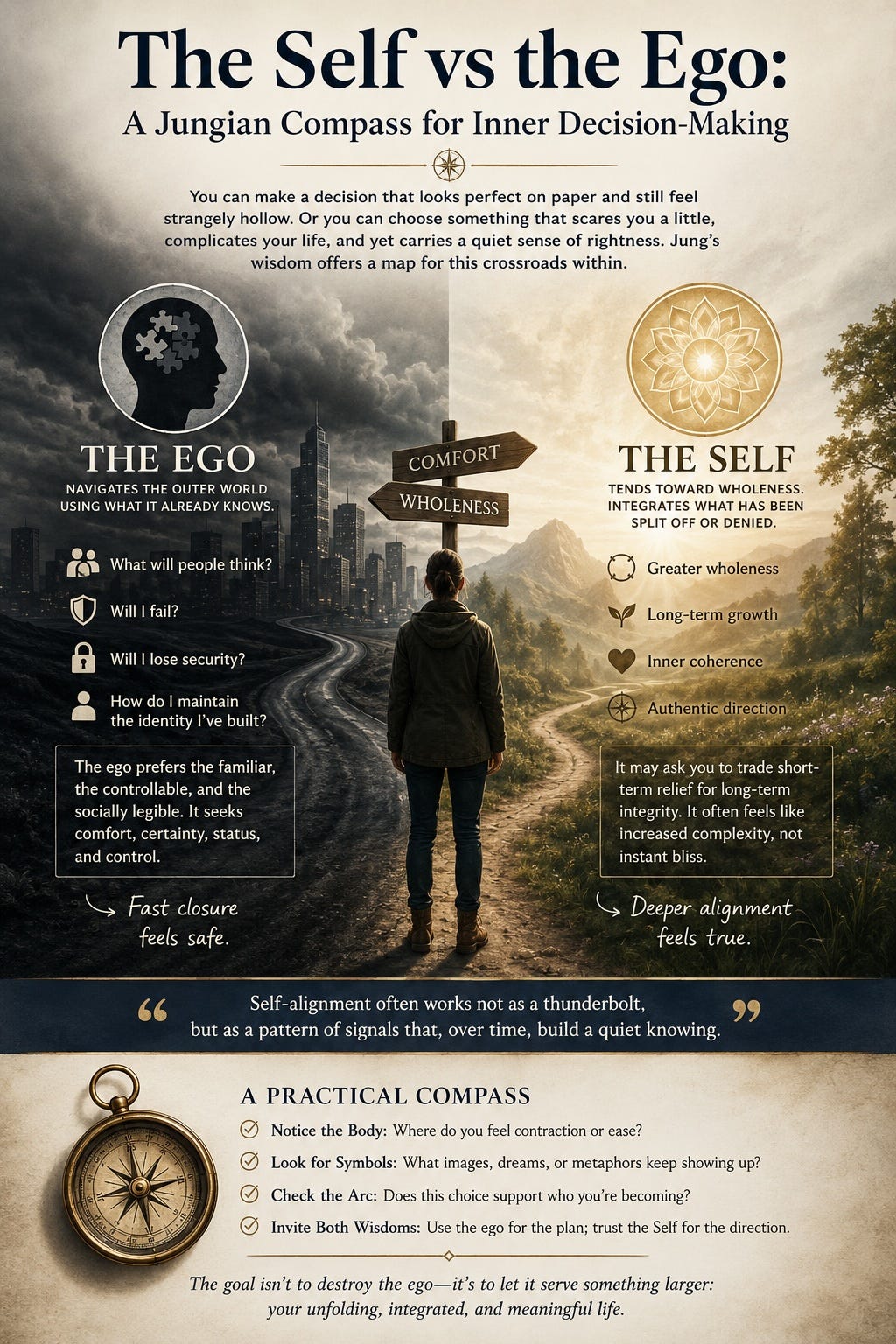
You can make a decision that looks perfect on paper and still feel strangely hollow. Or you can choose something that scares you a little, complicates your life, and yet carries a quiet sense of rightness. That uneasy mismatch—between what “makes sense” and what feels inwardly true—is one of the most common crossroads people bring to therapy, journaling, and late-night conversations with themselves. Jung’s language offers a useful map for this territory, not as mystical certainty, but as a practical way to notice what part of you is steering.
THESIS
In Jungian terms, the ego is the center of your conscious identity—what you know yourself to be, what you can explain, what you prefer, and what you can defend. The Self is larger: the organizing principle of the whole psyche, including what you don’t yet know about yourself. When we confuse ego preference with Self-oriented growth, we tend to chase comfort, status, or control and call it “intuition.” When we learn to listen for Self-alignment, we don’t get guaranteed answers—but we do gain a grounded compass: emotion, symbolism, and long-term coherence can help us sense whether a choice is merely protecting the current identity or inviting a more integrated one.
THE EGO: NECESSARY, LIMITED, AND OFTEN ANXIOUS
The ego gets a bad reputation in spiritual circles, but in Jungian psychology it isn’t a villain. The ego is essential. It’s the part of you that pays bills, keeps appointments, sets boundaries, and says “I am me.” Without a reasonably stable ego, life becomes chaotic.
The trouble starts when the ego assumes it should run the entire inner world. The ego’s job is to navigate the outer world using what it already knows. That means it tends to prefer the familiar, the controllable, and the socially legible. The ego often asks:
What will people think?
Will I fail?
Will I lose security?
How do I maintain the identity I’ve built?
Ego preferences aren’t inherently shallow. Wanting stability, recognition, and belonging are human needs. But ego preferences become misleading when they masquerade as the whole truth. Then you may notice a particular flavor of decision-making: urgency, tightening, justification, or a compulsive need to “lock in” certainty. The ego often pushes for fast closure because ambiguity feels like danger.
A simple example: someone stays in a respectable job they hate because it matches the identity they’ve invested in—competent, reliable, admired. The ego prefers the known pain to the unknown risk. It can produce excellent arguments for staying, and those arguments might not be wrong. They’re just incomplete.
THE SELF: NOT A GURU, BUT A DIRECTION OF WHOLENESS
If the ego is the center of consciousness, the Self is the center of the psyche as a whole. The Self isn’t a voice that always speaks in clear sentences. It’s more like an inner tendency toward wholeness—toward integrating what has been split off, denied, or underdeveloped. Jung associated the Self with symbols of totality: circles, mandalas, wise figures, divine children, unifying images. But you don’t need to treat those symbols as supernatural. They’re psychological expressions of a deep organizing movement in the psyche.
Self-oriented growth often feels paradoxical to the ego. It may require you to become less impressive and more honest. It may ask you to trade short-term relief for long-term integrity. It might lead you away from an identity you’ve outgrown, even if that identity has “worked.”
Importantly, the Self is not the same as a fantasy of destiny. People sometimes use “my higher self” language to bypass discomfort, responsibility, or relational reality. Self-orientation isn’t guaranteed to feel blissful, and it doesn’t grant moral superiority. It often feels like increased complexity: a wider view that includes your needs, your shadows, your limits, and your genuine values.
A SHORT ANECDOTE: THE PROMOTION THAT FELT LIKE A TRAP
Consider Maya (a composite example). She’s offered a promotion: more money, prestige, and a clear next step. Her ego is thrilled—until she notices a persistent dread that doesn’t fade. She tells herself she’s being ungrateful. She tries to “think positive.” But the dread returns, along with a recurring dream: she’s in a beautiful house with no doors.
Ego preference says: take it, don’t be foolish, this is success.
Self-direction might be hinting: you are building a life that looks good but restricts your psyche.
Maya doesn’t immediately reject the promotion. She slows down. She asks: what exactly feels doorless? In reflection, she realizes the role would require her to become more political and less creative, more managerial and less hands-on. She’s been ignoring a growing desire to mentor and teach, something that doesn’t fit her current identity as a high-achieving specialist.
She eventually negotiates a different role—less prestigious on paper, but with space to develop the part of her that’s been starving. The dread lifts, not because she found certainty, but because her choice gained inner coherence. The dream shifts: she’s still in the house, but she finds a hidden doorway.
This is how Self-alignment often works: not as a thunderbolt, but as a pattern of signals that becomes harder to ignore.
A GROUNDED COMPASS: THREE SIGNALS OF ALIGNMENT
If we avoid mystical certainty, what can we rely on? You can think of Self-alignment as something you test over time. It’s not one feeling. It’s a convergence of clues.
1) EMOTION: THE DIFFERENCE BETWEEN ANXIETY AND ALIVENESS
Emotion is data, not a verdict. The ego tends to interpret all discomfort as danger. But not all discomfort is the same.
Ego-protective discomfort often feels like contraction: tight chest, racing thoughts, a need to prove, a fixation on outcomes, a fear of humiliation. It says: “If this goes wrong, I will be diminished.”
Self-oriented discomfort can include fear too, but it’s often paired with aliveness: a sense of energy, curiosity, or meaningfulness. It says: “This matters. I’m not sure I can do it, but something in me wants to meet it.”
A practical experiment: imagine you choose Option A. Sit quietly and picture living with that choice for six months. Notice your body. Then do the same with Option B. You’re not looking for instant peace; you’re looking for the quality of the feeling. Does it feel like relief that comes from avoiding life, or relief that comes from telling the truth?
2) SYMBOLISM: DREAMS, REPEATED THEMES, AND “ACCIDENTAL” IMAGES
The unconscious often speaks in images rather than arguments. You don’t need to treat dreams as prophecies. Treat them as metaphors generated by your psyche.
Pay attention to recurring motifs:
Being chased, being late, losing your voice, finding a hidden room, missing a train, caring for a child, animals that frighten or guide you, broken bridges, flooded houses, locked doors, unfinished schools.
These images can reveal what your ego is not admitting. For example, a dream of constantly packing and never leaving might reflect a life of perpetual preparation—always “almost ready,” never committed. A dream of a neglected garden might point to creative life that’s been ignored.
You can ask simple questions:
What is the emotional tone of the image?
What part of me does this character or object represent?
If this dream were a story about my current decision, what would it be saying?
Symbolism also appears in waking life: the book that keeps catching your eye, the phrase you overhear, the repeated “coincidences” that cluster around a theme. Jung called this synchronicity, but you don’t have to decide whether it’s metaphysical. Psychologically, it may simply mean your attention is organizing around what matters.
3) LONG-TERM COHERENCE: DOES THIS CHOICE INTEGRATE OR SPLIT YOU?
Perhaps the most reliable compass is time. Ego choices often optimize for short-term comfort or image management. Self-oriented choices tend to create long-term coherence: your values, relationships, work, and inner life begin to align rather than compete.
Ask:
Will this choice make me more whole, or more divided?
Will I have to keep lying to myself to maintain it?
Does it enlarge my capacity for love, work, and responsibility—or shrink it?
Does it help me become more real, or more performative?
A key Jungian idea here is the shadow: the parts of you you’ve disowned. Self-orientation often includes shadow integration. That doesn’t mean indulging every impulse; it means acknowledging what’s been denied so it doesn’t sabotage you from behind the scenes.
For example, someone who identifies as “nice” may need to integrate assertiveness. Someone who identifies as “strong” may need to integrate grief. Someone who identifies as “the responsible one” may need to integrate play and desire. The Self doesn’t always ask you to be better; it often asks you to be broader.
COMMON PITFALLS: WHEN EGO DRESSES UP AS THE SELF
Because Self-language can sound noble, it’s easy for the ego to co-opt it. A few signs to watch for:
If your “inner truth” conveniently avoids accountability, it may be avoidance.
If your “growth” requires devaluing others, it may be inflation.
If you feel uniquely chosen, above ordinary limits, it may be grandiosity.
If you keep seeking a perfect sign before acting, it may be fear of commitment.
Self-alignment is usually humbler than the ego expects. It doesn’t always look impressive. It often looks like a steady willingness to face what’s real.
A SIMPLE PRACTICE: THE THREE-WAY CHECK-IN
When you’re stuck, try a three-way check-in over a week rather than a single moment.
First, write the ego’s case. Let it speak fully: what it wants, what it fears, what it’s protecting. Don’t shame it. The ego is often trying to keep you safe.
Second, invite the shadow’s perspective. Ask: what part of me is being ignored? What emotion am I disallowing? What do I secretly resent? What do I secretly want?
Third, ask for the Self’s direction—not as a supernatural command, but as a question of integration: “What choice helps me become more whole?” Then watch what emerges in dreams, body sensations, and repeated themes. You’re not hunting certainty; you’re observing coherence.
CONCLUDING TAKEAWAY
The difference between ego preference and Self-oriented growth isn’t that one is “wrong” and the other is “right.” The ego keeps you functioning; the Self keeps you developing. Decisions become clearer when you stop demanding a single definitive sign and instead look for a pattern: emotions that distinguish anxiety from aliveness, symbols that reveal what you’re not saying out loud, and long-term coherence that reduces inner division.
If you treat your psyche as something you can listen to—patiently, skeptically, compassionately—you’ll make fewer choices that merely preserve an outdated identity. And you’ll make more choices that, over time, feel like you are becoming yourself.
Subscribe if you want more grounded Jungian reflections and practical prompts for shadow work and inner decision-making. If you prefer a guided way to explore dreams, symbols, and patterns in your own life, Jungian Psyche Ai can be a helpful companion for that ongoing conversation with the unconscious.