You can spend years “working on yourself” and still feel like something inside keeps pulling you off course. You make a plan, you mean it, you even believe in it—then you find yourself repeating the same pattern, choosing the same kind of relationship, getting stuck in the same emotional loop. It can feel confusing, even a little humiliating: Why can’t I just do what I decided to do? Jungian psychology offers a simple but profound distinction that often brings immediate clarity: the ego is not the whole psyche.
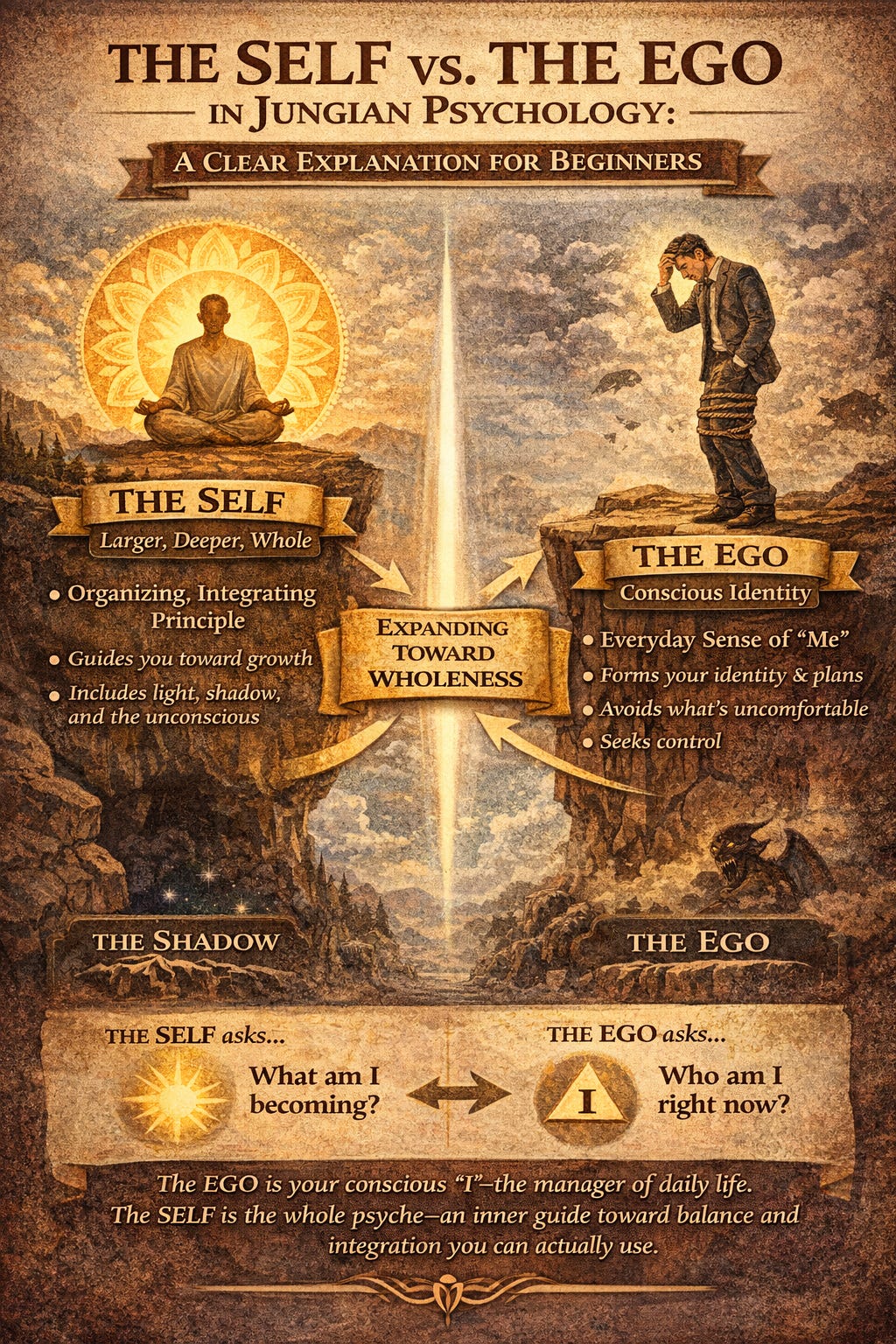
Thesis: In Jungian psychology, the ego is the center of conscious identity—your “I” and your everyday sense of who you are—while the Self is the larger organizing principle of the entire psyche, guiding growth toward wholeness. Understanding the difference helps you interpret inner conflict, dreams, strong emotions, and repeating patterns as meaningful signals rather than personal failures.
WHAT THE EGO IS (AND WHY IT MATTERS)
In Jungian terms, the ego is the center of consciousness. It’s the part of you that says, “This is me,” and “This is what I want,” and “This is what’s happening.” It organizes your daily life: your plans, your preferences, your roles, your personal story, and your sense of continuity from yesterday to today.
A practical way to recognize the ego is to notice how quickly it forms identity statements:
“I’m the responsible one.”
“I’m the funny one.”
“I’m not a jealous person.”
“I’m an introvert.”
“I’m the type who never quits.”
These statements aren’t inherently bad. In fact, you need them. Without an ego, you wouldn’t be able to function. You wouldn’t be able to make decisions, maintain boundaries, or build a coherent life. The ego is necessary for reality-testing: paying bills, driving safely, showing up to work, remembering your commitments, and navigating social norms.
But the ego has limits. It only knows what it knows. It only identifies with what it can comfortably hold in awareness. And it tends to protect its image. This is where trouble begins: the ego often confuses itself with the whole psyche. When that happens, anything that doesn’t fit the ego’s self-image gets pushed away, denied, or projected.
A short example: imagine someone who prides themselves on being “easygoing.” Their ego identity is calm, agreeable, low-maintenance. Then they feel intense anger when a friend repeatedly disrespects them. Instead of seeing anger as a signal (“a boundary is being crossed”), they might judge themselves: “Why am I being so dramatic?” Or they might repress it until it leaks out as sarcasm, passive aggression, or sudden blow-ups. The ego tries to preserve its identity, even at the cost of honesty.
WHAT THE SELF IS (AND WHY IT FEELS MYSTERIOUS)
The Self, in Jungian psychology, is bigger than the ego. It’s the totality of the psyche: conscious and unconscious, known and unknown, light and shadow, personal and archetypal. Jung described the Self as an organizing principle—like a central intelligence that coordinates the psyche’s movement toward wholeness.
If the ego is the captain on the bridge, the Self is more like the entire ship’s design and navigation system, including the parts below deck you rarely see. The ego steers based on what it can perceive. The Self “wants” integration: not perfection, but completeness. Not a flawless personality, but a more truthful one.
This is why the Self can feel strange or even unsettling at first. The Self does not always prioritize comfort. It prioritizes growth. Sometimes growth looks like losing an identity you’ve outgrown. Sometimes it looks like being forced to face what you’ve avoided. Sometimes it looks like feeling called toward a life that doesn’t match the persona you’ve been performing.
A relatable example: someone has built an identity around being “the achiever.” They’re competent, productive, admired. Their ego likes the certainty: goals, metrics, praise. Then, seemingly out of nowhere, they hit a wall—fatigue, emptiness, loss of meaning. The ego says, “Work harder. Fix it. Optimize.” But the deeper psyche may be signaling a new developmental task: feeling, relationship, creativity, spirituality, or rest. In Jungian terms, the Self may be pressuring the personality to expand beyond one-sidedness.
EGO VS. SELF: A SIMPLE WAY TO TELL THEM APART
One of the clearest beginner distinctions is this:
The ego asks: “Who am I right now, and how do I keep my life coherent?”
The Self asks: “Who am I becoming, and what must be integrated for me to be whole?”
The ego tends to be concerned with stability, reputation, and control.
The Self tends to be concerned with balance, truth, and development.
The ego often prefers a single narrative: “I’m this kind of person.”
The Self holds paradox: “I am more than I thought—both/and, not either/or.”
This doesn’t mean the ego is “bad” and the Self is “good.” The goal isn’t to destroy the ego. The goal is a healthier relationship between ego and Self, where the ego becomes a capable partner rather than a rigid ruler.
A brief anecdote: consider someone who sees themselves as “the caretaker.” They’re always helping, always listening, always rescuing. Their ego identity is built on being needed. Then they enter therapy or begin honest reflection and discover resentment underneath—resentment at being taken for granted, resentment at never being cared for, resentment at their own inability to say no. The ego might panic: “If I stop caretaking, who am I?” The Self might be inviting a new integration: assertiveness, boundaries, receiving, and a more equal kind of love.
THE SELF AND THE SHADOW: WHY YOU CAN’T “THINK” YOUR WAY TO WHOLENESS
The shadow is the part of the psyche that contains what the ego does not identify with. It’s not only “bad” traits. It can include positive potentials too—confidence, sensuality, ambition, creativity—if those qualities didn’t fit your early environment or your self-image.
The ego often says: “That’s not me.”
The shadow says: “But it is in you.”
And the Self? The Self is the larger wholeness that includes both ego and shadow. This is why shadow work is not about self-hatred or digging for flaws. It’s about reclaiming psychic energy that’s been split off. When you integrate shadow material, you don’t become worse—you become more real, less brittle, less reactive.
A common everyday sign of shadow activation is disproportionate emotional charge. If you feel an outsized reaction to someone—intense irritation, disgust, envy, fascination—ask yourself: “What quality is being constellated here?” Sometimes you’re seeing your own disowned trait. Sometimes you’re encountering a genuine boundary issue. The point isn’t to blame yourself; it’s to get curious about what the psyche is trying to show you.
THE SELF SPEAKS IN SYMBOLS: DREAMS, SYNCHRONICITY, AND INNER “PULLS”
Because the Self includes the unconscious, it rarely communicates in straightforward ego-language. It speaks through symbols, images, moods, dreams, sudden insights, repeating patterns, and sometimes meaningful coincidences that catch your attention.
Dreams are a classic example. A dream might present you as a child in a house you’ve never seen, or show an animal, a storm, a locked room, a stranger, a wedding, a death. The ego might dismiss it as random. A Jungian lens asks: “What is the psyche trying to balance? What is compensating for my conscious attitude?”
For instance, a person who is overly controlled in waking life might dream of a flood. The ego says, “I hate this. It’s chaos.” The Self might be signaling that emotion is being dammed up, and something needs to move. Or someone living too much in their head may dream of being unable to speak—suggesting a disconnect between intellect and authentic expression.
You don’t need to be “mystical” to work this way. You only need to treat inner material as meaningful rather than disposable.
PRACTICAL REFLECTION: HOW TO WORK WITH EGO AND SELF IN DAILY LIFE
A helpful practice is to notice when you’re speaking from ego and when something deeper is trying to emerge.
Try these reflection prompts in a journal, during a walk, or in a quiet moment before sleep:
1) What identity am I trying to protect right now?
Maybe it’s “the good one,” “the strong one,” “the rational one,” “the successful one,” or “the independent one.” Naming it reduces its unconscious grip.
2) What emotion keeps returning, even when I try to outthink it?
Recurring anger, sadness, boredom, envy, or anxiety often points to a neglected truth. The question isn’t “How do I get rid of it?” but “What is it asking me to acknowledge?”
3) Where do I feel split?
“I want closeness, but I fear it.”
“I want freedom, but I crave approval.”
“I want to change, but I’m loyal to who I used to be.”
These splits are often places where the Self is pressing for integration.
4) If my life is a story, what is the next developmental chapter?
Not the next achievement. The next chapter. Sometimes the psyche wants a new capacity: boundaries, patience, play, grief, courage, receptivity, or self-respect.
5) What do I keep projecting onto others?
Who do you judge harshly? Who do you idealize? Who do you envy? Projections are not “bad”; they’re clues. They show where psychic energy is invested outside the self, waiting to be reclaimed.
THE GOAL: EGO-Self RELATIONSHIP, NOT EGO DEFEAT
In healthy development, the ego becomes more flexible and more honest. It learns to listen. It learns that not everything uncomfortable is wrong. It learns that being a person is bigger than maintaining a brand.
Meanwhile, the Self does not erase individuality. It deepens it. The paradox is that you become more uniquely yourself by integrating what you once rejected. Wholeness isn’t about becoming saintly; it’s about becoming less divided.
A simple sign you’re moving in that direction: you feel less compelled to prove who you are. You’re more able to hold complexity. You can admit, “Part of me wants this, and part of me fears it,” without collapsing into shame or rigid certainty. You can make room for the full psyche to speak.

CONCLUDING TAKEAWAY
The ego is your conscious “I,” the manager of daily life and identity. The Self is the larger psychic totality, an organizing principle that draws you toward wholeness. When you feel inner conflict, repeating patterns, or emotional intensity, it may not mean you’re broken—it may mean the ego is being invited into a wider relationship with the Self. The work is not to silence the ego, but to help it become a trustworthy participant in a bigger, truer life.
If you enjoy this kind of reflection and want a guided way to explore dreams, shadow themes, and recurring patterns, subscribe if you’d like more Jungian concepts translated into practical inner work you can actually use.