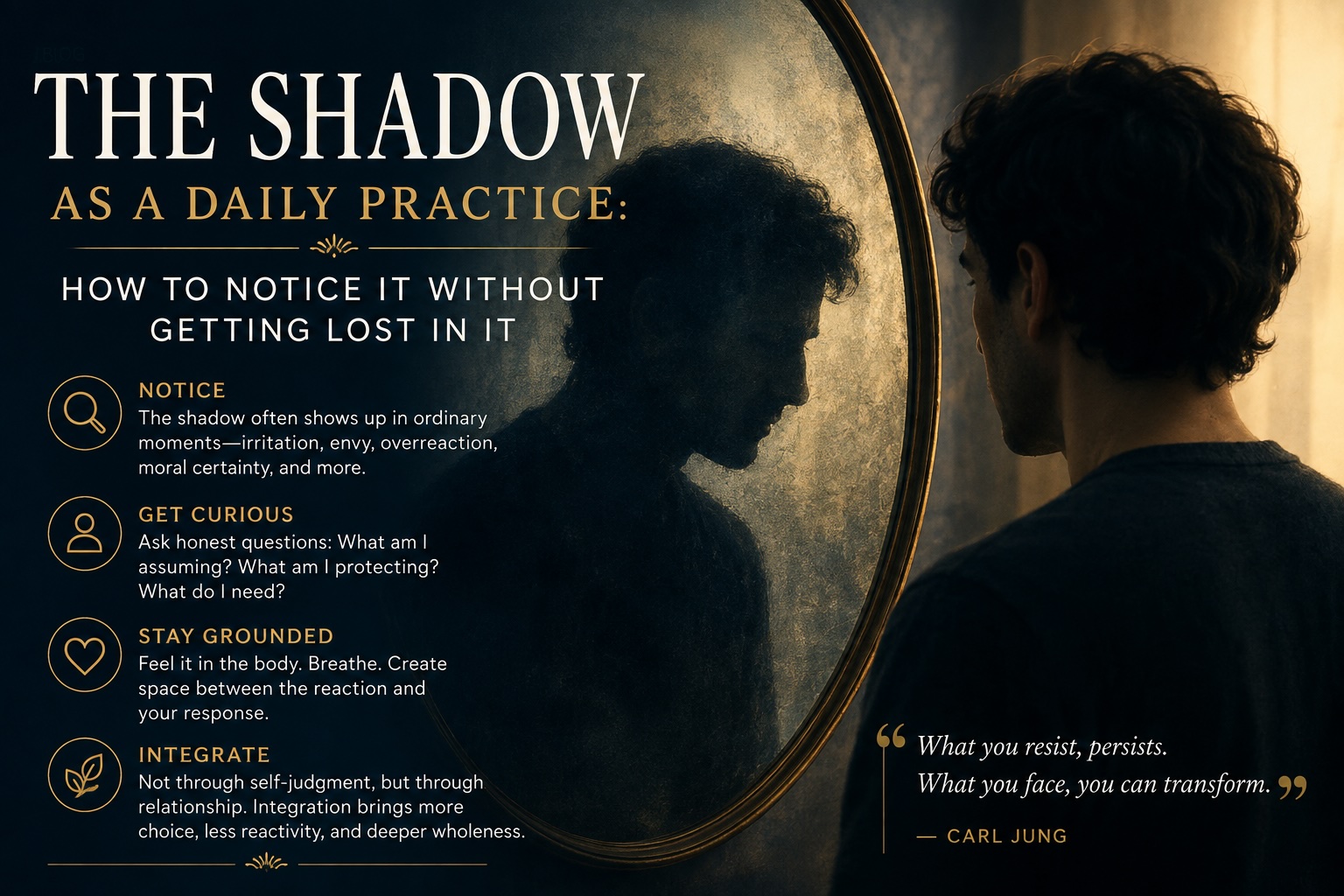
You’re standing in line for coffee, and someone steps a little too close behind you. Your shoulders tighten. You feel a flash of irritation that’s bigger than the situation deserves. You tell yourself, “Relax,” but the heat doesn’t go away. In fact, it starts recruiting a story: People are so inconsiderate. Nobody has manners anymore. And suddenly, you’re not just waiting for coffee—you’re in a quiet battle with the world.
If this sounds familiar, it’s not a sign that you’re failing at self-awareness. It’s a sign that you’re human.
Here’s the thesis: the shadow doesn’t only appear in dramatic breakdowns or big life crises. More often, it shows up in ordinary moments—irritation, envy, overreaction, moral certainty, subtle contempt, compulsive pleasing, “harmless” gossip, and the urge to be right. Shadow work, then, doesn’t have to be a heavy excavation project. It can be a daily practice of gentle noticing: recognizing what got activated, staying grounded in the body, and asking a few honest questions without trying to immediately fix or perfect yourself.
WHAT “THE SHADOW” LOOKS LIKE ON A TUESDAY
In Jungian terms, the shadow is the set of qualities we disown, repress, or fail to recognize in ourselves—traits that don’t fit our conscious self-image. The shadow isn’t only “bad.” It can include healthy aggression, confidence, erotic vitality, ambition, vulnerability, and creativity—anything that was discouraged, shamed, or simply not mirrored by your environment.
The reason the shadow matters is simple: what isn’t owned tends to be projected. We experience it “out there,” in other people, in groups, in partners, in coworkers. The shadow doesn’t announce itself with a label. It arrives as a mood, a judgment, a sudden certainty, a compulsion, or a disproportionate emotional charge.
You can often spot shadow material by its intensity. The situation is small; the reaction is large. Or the reaction is repetitive. Or it has a sticky quality that lingers long after the moment passed.
Here are a few everyday disguises: You feel irrationally irritated by someone’s tone. You roll your eyes at someone’s enthusiasm. You feel a sharp pang of envy, then quickly rationalize it away. You have an overreaction to being corrected. You feel compelled to “help” someone who didn’t ask. You feel the urge to expose someone’s flaws to others. You feel superior for being “more aware” or “more ethical.” You become unusually defensive, or unusually eager to please.
None of these make you a bad person. They make you a person with an unconscious.
THE GOAL ISN’T TO “FIX” THE SHADOW
A common trap is to approach shadow work like a self-improvement project: identify the flaw, correct it, become better. That mindset can turn inner work into an internal courtroom, where one part of you prosecutes another.
But the shadow isn’t integrated through punishment. It’s integrated through relationship—through bringing curiosity, honesty, and containment to what you’d rather not see.
Gentle observation is not passive. It’s disciplined. It means you’re willing to stay present with discomfort long enough to learn what it’s trying to show you. Instead of “How do I get rid of this?” the question becomes: “What is this reaction protecting? What is it asking for? What part of me is trying to come back into the picture?”
Integration often looks less like a dramatic breakthrough and more like a subtle shift: you catch the projection sooner, you soften the story, you regain choice.
IRRITATION: THE SHADOW’S SMOKE ALARM
Irritation is one of the most useful daily signals because it’s common and socially acceptable. You can be irritated and still appear “fine.” That makes it a perfect hiding place for disowned feelings—anger, fear, helplessness, grief, shame.
Imagine this: a coworker sends a short message—“Need this by end of day.” No greeting, no context. You feel a surge of annoyance. You start drafting a sharp reply. Your mind says, They’re disrespectful.
Pause and consider a shadow-friendly angle: what else could be happening inside you? Maybe you’re carrying unacknowledged resentment about being taken for granted. Maybe you have a history of feeling controlled, and the message touches that old bruise. Maybe you disown your own need for boundaries, so it shows up as irritation when someone crosses them. Maybe you’re afraid you can’t deliver, and irritation is covering anxiety.
The practice isn’t to deny the boundary issue. It’s to separate the present moment from the emotional inheritance attached to it. You might still respond firmly. But you can respond from choice rather than charge.
A grounded micro-practice for irritation: Name it plainly: “I’m irritated.” Locate it in the body: jaw, chest, throat, belly. Slow the exhale once or twice. Ask: “What am I assuming right now?” Then: “What do I need that I’m not admitting?”
Often the need is simple: respect, time, clarity, autonomy, appreciation, rest.
ENVY: A COMPASS DISGUISED AS A SIN
Envy is another everyday doorway into the shadow. Many people treat envy as proof of pettiness, so they suppress it quickly. But envy can be a compass: it points toward a desire you haven’t fully owned, or a life energy you’ve disallowed yourself.
Picture scrolling through social media and seeing someone announce a new job, a book deal, a relationship, a trip. You feel a quick sting, then a story: Must be nice. They probably had help. Or you turn it inward: I’m behind. I’m failing.
Instead of shaming yourself for envy, try extracting its information.
Ask: “What exactly am I envious of?” Is it their freedom? Their recognition? Their courage? Their consistency? Their beauty? Their community? “What does this say about what I want?” “What do I tell myself about why I can’t have it?” “What do I fear would happen if I pursued it?”
Envy can also reveal a disowned strength. Sometimes we envy what we refuse to embody: visibility, ambition, sensuality, leadership, playfulness. The shadow doesn’t only contain what’s “ugly.” It contains what feels dangerous to claim.
Working with envy doesn’t mean you must chase the same outcome. It means you stop lying to yourself about what you long for.
OVERREACTION: WHEN THE PAST BORROWS THE PRESENT
Overreaction is often the clearest sign that an old complex has been activated. A complex, in Jungian language, is a cluster of emotions, memories, and beliefs that constellates around a theme—abandonment, humiliation, betrayal, inadequacy, control.
A partner forgets to respond to a text for a few hours. You feel panic. Or rage. Or you decide they don’t care. The intensity may not be about the text. It may be about a familiar inner landscape: being unseen, being left, being unimportant.
The daily practice here is to create a small gap between trigger and conclusion.
Try this three-step reset:
- “This is activation.”
- “What am I afraid this means about me?”
- “What is the most grounded interpretation available right now?”
You’re not forcing optimism. You’re widening the frame.
If you can, add a fourth step: offer the activated part of you a sentence of reassurance, not as a performance but as contact. “I see you. This feels familiar. We’re here now.”
This is how you prevent shadow work from becoming drama. You don’t deny the feeling; you contain it.
PROJECTION: THE FASTEST WAY TO MEET YOUR SHADOW
Projection is when we attribute to others what we can’t (or won’t) see in ourselves. It can be negative (“They’re selfish”) or positive (“They’re perfect”). Either way, the emotional charge is a clue.
A short anecdote: someone I once knew couldn’t stand a particular colleague. “He’s so arrogant,” she’d say, repeatedly, with real heat. Over time, it became clear she had a strong, disowned confidence of her own—one that had been labeled “too much” earlier in life. The colleague’s overt self-assurance wasn’t only irritating; it was a mirror. Her psyche was saying: there’s a part of you that wants to stand taller.
When you feel a strong judgment, consider these prompts: “What quality am I reacting to?” “Where do I show this, even subtly?” “Where do I fear I show this?” “Where might I need a healthier version of this quality?”
Sometimes the answer is, “I don’t do that at all.” But even then, the question can reveal what you’re protecting. For example, harsh judgment of “needy people” often guards against one’s own vulnerability and longing.
A GROUNDED METHOD: NOTICE, NAME, NORMALIZE, NEGOTIATE
Shadow work becomes daily practice when it’s simple enough to use in real time.
NOTICE: Catch the signal. Tightness, heat, urgency, contempt, craving, collapse. NAME: Put words to it without analysis. “Envy.” “Defensiveness.” “A need to be right.” “Shame.” NORMALIZE: “Of course this is here.” Not as an excuse—just as a release from self-attack. NEGOTIATE: Ask what the moment requires. A boundary? A repair? A pause? A truth? A softer interpretation? A nap?
“Negotiate” matters because the shadow often carries legitimate needs, just expressed in distorted ways. The task is to translate the need into an adult form.
For example: Shadow expression: passive-aggressive silence. Possible need: to be heard without fear of conflict. Adult action: “I felt dismissed earlier; can we revisit that?”
Shadow expression: snide superiority. Possible need: to feel secure or valued. Adult action: name insecurity, ask for feedback, reconnect to purpose.
When you treat the shadow as information rather than an enemy, you gain options.
REFLECTION PROMPTS FOR A NON-DRAMATIC SHADOW PRACTICE
Use these as a short evening check-in, or in the moment when you feel charged:
- What moment today had an emotional charge that felt bigger than the situation?
- What story did my mind immediately tell?
- What feeling was underneath the story (hurt, fear, shame, longing, anger)?
- What quality in the other person did I judge or idealize?
- Where does that quality live in me—past or present, obvious or hidden?
- What did I need in that moment that I didn’t ask for?
- If I could redo the moment with 10% more consciousness, what would I do?
Notice the tone: these questions aren’t “What’s wrong with me?” They’re “What’s happening in me?”
CONCLUDING TAKEAWAY: SMALL HONESTY, DONE OFTEN
The shadow doesn’t require you to become a different person overnight. It asks for small honesty, practiced consistently. The daily path is not about hunting for darkness; it’s about meeting your reactions with enough steadiness that they can reveal their meaning.
When irritation flares, envy stings, or an overreaction takes over, you don’t have to spiral into shame or turn it into a dramatic identity statement. You can treat it as a signal: something in me wants attention, truth, or integration. Then you return to the simplest discipline—notice, name, normalize, negotiate—and let the moment teach you without consuming you.
If you want a gentle way to keep this practice going, consider using a guided journaling conversation with Jungian Psyche Ai on iOS or on the web. Sometimes one well-aimed question is all it takes to turn a charged moment into insight.