If you’ve ever tried to “go inward” and found the inner world didn’t feel poetic or enlightening—but instead flooded you with dread, numbness, or a sudden urge to shut down—you already know something important: the unconscious isn’t always a gentle teacher. Sometimes it’s a storm system. Jungian psychology offers a language for that inner weather: shadow, complexes, dissociation, symbols, dreams. But trauma adds a crucial reality check: not everything that emerges from the depths is ready to be interpreted, and not every descent is wise to take alone.
THESIS
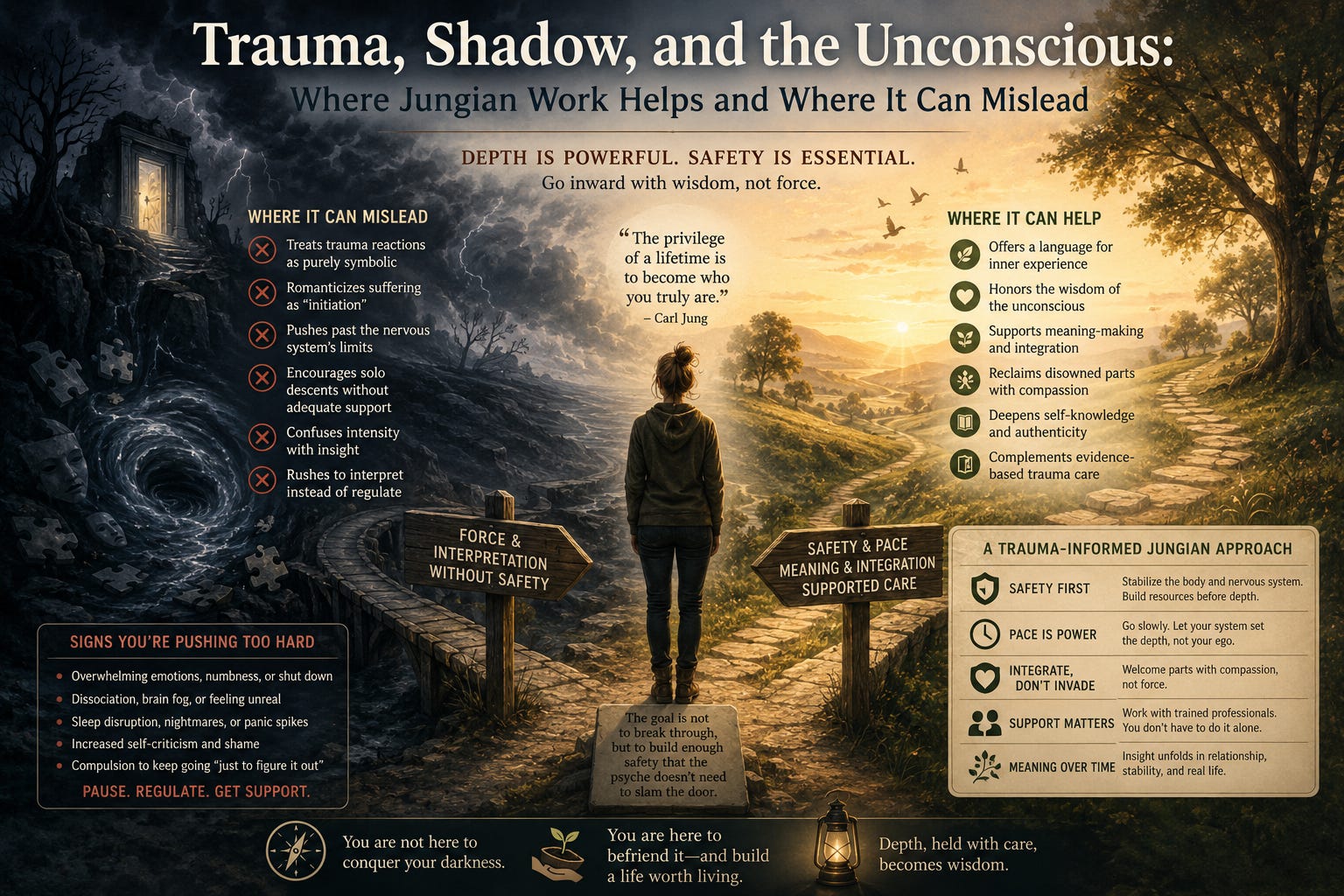
Jungian work can be deeply supportive for trauma recovery when it emphasizes safety, pacing, and meaning-making without forcing exposure; it can mislead when it treats trauma reactions as purely symbolic, romanticizes suffering as “initiation,” or encourages people to push past their nervous system’s limits instead of collaborating with evidence-based care.
TRAUMA CHANGES THE RULES OF “GOING DEEP”
In many Jungian circles, “going deeper” is framed as progress: more dreams, more shadow material, more confrontation with what we’d rather avoid. With trauma, depth has to be redefined. Trauma is not just a story in the mind; it’s also a pattern in the body and nervous system. A person may sincerely want insight, but their system may interpret certain inner experiences as danger and respond with fight, flight, freeze, collapse, or dissociation.
A simple example: someone begins journaling about a painful childhood memory. Within minutes, their thoughts scatter, their vision blurs, and they feel unreal—like they’re watching their life from far away. In a purely interpretive frame, they might label this “resistance” or “the shadow protecting itself.” Sometimes that’s partly true. But clinically, it may also be dissociation: the nervous system’s emergency brake. If we treat that brake as a moral failing or a puzzle to outsmart, we risk reinforcing shame and destabilization. If we treat it as a protective response, we can work with it respectfully.
This is where trauma reality improves Jungian practice: it teaches that the psyche’s defenses are often intelligent, even when they’re painful. The question becomes less “How do I break through?” and more “How do I build enough safety that the psyche doesn’t need to slam the door?”
WHAT “SHADOW” CAN MEAN IN A TRAUMA CONTEXT
The shadow, in Jungian terms, is often described as what we disown: impulses, emotions, traits, needs, and potentials we learned were unacceptable. In trauma recovery, “shadow” can include obvious candidates like rage, grief, desire, dependency, envy, and selfishness. But it can also include something more tender: the right to exist, the right to take up space, the right to be protected.
A short anecdote: a high-functioning professional feels “irrationally” angry when a colleague interrupts her. In reflection, she discovers the anger isn’t just about the meeting; it’s the part of her that learned early on that speaking up invited punishment. Her “shadow” isn’t simply aggression—it’s assertiveness, dignity, and self-protection that were pushed underground to survive. When that part returns, it may come back as heat, sharpness, even fantasies of retaliation. Shadow work here isn’t about suppressing anger or unleashing it; it’s about integrating the underlying need and restoring choice.
A clinically cautious shadow approach asks:
Is this “shadow” material actually a disowned quality, or is it a trauma response?
Is it safe to contact it right now?
What resources—internal and external—support integration?
When shadow work is paced well, it can reduce self-hatred. People stop seeing themselves as broken and start seeing themselves as adapted. That shift alone can be healing.
COMPLEXES, TRIGGERS, AND THE “AUTONOMOUS” PSYCHE
Jung’s concept of complexes—emotionally charged clusters of memory, sensation, and belief that can take over consciousness—maps surprisingly well onto what many people call “getting triggered.” A complex can hijack perception: a neutral tone becomes contempt; a delayed text becomes abandonment; a minor critique becomes humiliation.
This is one of Jungian psychology’s strengths: it normalizes the feeling of being “not yourself” at times without labeling you as crazy. It also offers a practical stance: when a complex is activated, you’re not in full choice. The goal is not to win an argument with yourself, but to re-orient to the present and restore enough stability to reflect.
But there’s a common pitfall: interpreting every trigger as a symbolic message to decode immediately. Sometimes a trigger is simply a nervous system alarm. The first task is regulation, not revelation. Meaning can come later.
A grounded approach might look like:
First: “What is happening in my body? Can I slow down, feel my feet, soften my eyes, breathe?”
Then: “What story is my mind telling? What does this remind me of?”
Later: “Is there an image, dream, or pattern that helps me understand what this part needs?”
This sequence respects both trauma physiology and Jungian meaning-making.
DREAMS AND SYMBOLS: POWERFUL, BUT NOT A SUBSTITUTE FOR CARE
Dreamwork can be a gentle entry point into the unconscious because it speaks in metaphor. For trauma survivors, dreams may also be intense: nightmares, repetitions, scenes of pursuit, helplessness, or grotesque imagery. It can be tempting to treat these as purely symbolic—“the monster is your shadow” or “the chase is your individuation.” Sometimes symbolic framing helps reduce fear. But it can also bypass the raw truth: some nightmares are the psyche’s attempt to metabolize overwhelming experience, and some are the brain replaying threat patterns.
A cautious Jungian stance is to hold multiple possibilities at once. A nightmare can be:
A replay of trauma memory fragments
A rehearsal of threat to maintain vigilance
A symbolic dramatization of inner conflict
A communication from a dissociated part of the self
You don’t have to pick one interpretation quickly. In fact, rushing to interpret can become a way to avoid feeling. The goal is not to “solve” the dream; it’s to build relationship with the psyche while staying within a tolerable window of experience.
If someone wakes from a nightmare in panic, it may be more helpful to do simple grounding first than to analyze the symbol. Later, when calm returns, the dream can be approached with curiosity: “What was the emotion? What did the dream-self need? What would have helped in that scene?” This invites integration without forcing exposure.
WHERE JUNGIAN WORK CAN MISLEAD: SPIRITUALIZING AND ROMANTICIZING PAIN
One of the most seductive traps in depth psychology is the idea that suffering automatically equals transformation. Trauma can indeed catalyze growth, but it can also injure, distort, and constrict. If we frame trauma as a chosen “initiation” or imply that a person’s psyche “needed” it for individuation, we risk moralizing harm and subtly blaming the survivor.
Another misleading move is to treat symptoms as a sign of superiority or special destiny: “Your anxiety means you’re sensitive,” “Your dissociation means you’re mystical,” “Your depression is a dark night that you must endure alone.” Sometimes these frames offer meaning, but they can also keep people stuck and isolated.
Clinically cautious Jungian work avoids:
Encouraging people to relive trauma to “integrate” faster
Assuming every symptom is a message rather than a signal of overwhelm
Replacing treatment with interpretation
Equating endurance with progress
A healthier frame is modest: your psyche is doing its best. Healing is not a heroic plunge; it’s often a series of small, repeated returns to safety.
PACING: THE ART OF NOT FLOODING THE SYSTEM
A key trauma-informed principle is titration: approaching difficult material in small doses, then returning to stabilization. Jungian work can align with this beautifully when it respects rhythm. You can touch the shadow and then come back to ordinary life. You can explore one image, one feeling, one memory fragment, and then stop.
A practical example: someone notices a surge of shame after making a small mistake. Instead of diving into childhood scenes for an hour, they might spend five minutes identifying the shame’s voice, naming it as a part (“the inner critic”), and offering a counter-message (“I’m allowed to learn”). Then they do something regulating: a walk, a shower, a meal, a conversation with a trusted friend. This is not avoidance. It’s integration through dosage.
Over time, the psyche learns: we can visit this territory and return safely. That learning is often more transformative than any single dramatic insight.
COLLABORATION WITH EVIDENCE-BASED CARE: BOTH/AND, NOT EITHER/OR
Jungian psychology excels at meaning, identity, and the long arc of becoming. Evidence-based trauma care often excels at stabilization, symptom reduction, and restoring functional capacity. These are not enemies. They can be allies.
Some people benefit from therapies specifically designed for trauma (for example, approaches that focus on nervous system regulation, structured processing, or skills for managing dissociation). Others need medication support for a period. Some need a stable therapeutic relationship before any deep symbolic work is wise. Jungian exploration can complement these by helping a person answer: “Who am I beyond what happened?” and “What wants to live in me now?”
A good rule of thumb: if inner work consistently leaves you more dysregulated—more panicky, numb, self-harming, unable to sleep, unable to function—then “more shadow work” is not necessarily the answer. More support and more structure might be.
A SAFE WAY TO THINK ABOUT THE UNCONSCIOUS
The unconscious isn’t only a vault of repressed pain. It’s also a reservoir of creativity, instinct, and life force. Trauma can make it feel like the unconscious is dangerous, because what rises first is often what was buried in emergency. But with pacing, the unconscious can become a place where lost capacities return: play, boundaries, pleasure, trust, anger that protects, grief that clears, love that doesn’t abandon the self.
The aim is not to conquer the shadow. The aim is to build a relationship with it—one that is firm, kind, and grounded in reality.

Daily Stoicism
Think clearly. Act intentionally.
Most people consume ideas.
This helps you practice them.
Daily Stoicism gives you structured, guided practices—rooted in Stoic philosophy—to help you navigate challenges, build discipline, and act with clarity each day.
Not passive reading.
A system for living.
Explore Daily Stoicism
Guided Stoic practice, reflection, and insight—on iOS and the web
Web: https://dailystoicism.app/
iOS: https://apps.apple.com/app/daily-stoicism/id6760995265
CONCLUDING TAKEAWAY
Jungian concepts can offer profound companionship on the trauma path, especially when they’re used to reduce shame, honor protective parts, and invite meaning at a pace the nervous system can tolerate. The work misleads when it pushes intensity over safety, interpretation over regulation, or destiny over discernment. If you treat your psyche like a living ecosystem—one that needs shelter, time, and steady attention—shadow work becomes less like a plunge into darkness and more like learning to carry a lantern.